

International Youth Day 2026: India’s Youth Power and the Road to a Developed India
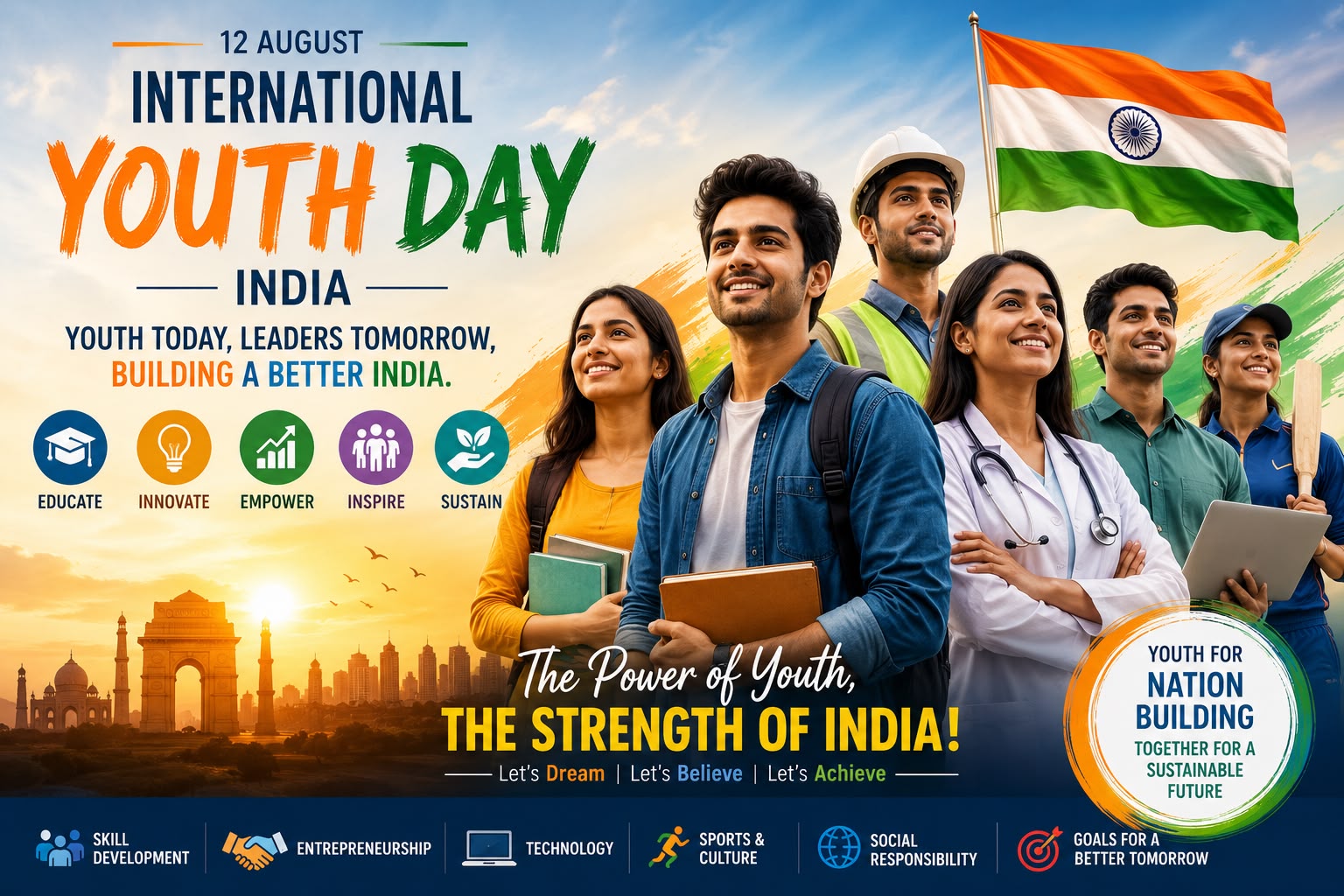
International Youth Day 2026: India’s Youth Power and the Road to a Developed India
International Youth Day 2026 is an opportunity to celebrate the energy, ambition, creativity and determination of young people across the world—and particularly the growing contribution of India's youth to the country's economic and social transformation.
Observed annually on 12 August, International Youth Day highlights the importance of empowering young people through education, skills, employment, entrepreneurship, innovation and meaningful participation in society.
For India, the occasion has special significance. With one of the world's largest young populations, India has a tremendous opportunity to convert its demographic strength into economic and social progress.
From startups and digital technology to manufacturing, sports, science, renewable energy and public service, young Indians are increasingly becoming an important force behind the country's growth story.
International Youth Day 2026: Date and Significance
International Youth Day is observed every year on 12 August.
The United Nations introduced the observance to draw global attention to issues affecting young people and encourage greater youth participation in economic, social and political development.
In India's context, the day represents more than a celebration. It is a reminder of the enormous responsibility and opportunity associated with the country's young population.
India's future growth will depend significantly on how effectively it can educate, skill, employ and empower its young citizens.
India’s Youth: A Major National Strength
India's young population is one of the country's most important economic advantages.
A large working-age population can provide India with a powerful workforce, a growing consumer base and an expanding pool of entrepreneurs, innovators and skilled professionals.
However, demographic strength becomes an advantage only when young people have access to quality education, relevant skills, productive employment and opportunities to participate in the economy.
This makes youth development a central part of India's long-term growth strategy.
From Young Population to Demographic Dividend
India has often been described as a country with significant demographic dividend potential.
A demographic dividend can emerge when a large share of the population enters the working-age group and contributes to economic activity.
For India, this opportunity can support:
- Higher workforce participation
- Increased productivity
- Greater entrepreneurship
- Stronger domestic consumption
- Expansion of manufacturing
- Growth of the digital economy
- Increased innovation
- Higher household incomes
The challenge is to ensure that India's young population is equipped with the right skills for the jobs and industries of the future.
Skill Development: Preparing India’s Youth for Tomorrow
As industries rapidly adopt artificial intelligence, automation, robotics, electric mobility and advanced manufacturing, traditional skills are evolving.
India's youth therefore need continuous opportunities for skill development and reskilling.
Programs and initiatives associated with skill development, vocational education, apprenticeships and entrepreneurship can help young Indians become more competitive in both domestic and international markets.
The future workforce will require a combination of technical knowledge, digital literacy, communication skills, creativity and problem-solving abilities.
India’s Startup Generation
One of the most visible examples of India's youth-driven transformation is the country's startup ecosystem.
Young entrepreneurs are building businesses across sectors such as:
- Fintech
- E-commerce
- Artificial intelligence
- Health technology
- EdTech
- Electric vehicles
- Renewable energy
- Agritech
- Logistics
- Semiconductor technology
- Digital services
Many young founders are no longer looking only at the Indian market. They are developing products and services for customers around the world.
This entrepreneurial culture can play a major role in India's ambition to become a high-income and globally competitive economy.
Youth and India’s Digital Transformation
India's digital transformation has created new opportunities for young people.
Digital payments, online education, e-commerce, digital public infrastructure, artificial intelligence and mobile connectivity are changing the way Indians study, work and conduct businesses.
For India's youth, technology has reduced geographical barriers and created opportunities to learn, work and build businesses from locations across the country.
The growth of India's digital economy is also creating demand for professionals in software development, cybersecurity, data science, AI, cloud computing and other emerging technologies.
Young Indians and Make in India
India's youth will be at the centre of the country's manufacturing ambitions.
As India strengthens its position in electronics, automobiles, electric vehicles, defence manufacturing, pharmaceuticals, renewable energy and semiconductors, millions of skilled workers and professionals will be required.
Young engineers, technicians, entrepreneurs and manufacturing professionals can become a critical part of this transformation.
The combination of skills, technology and manufacturing capability can help India strengthen its position in global supply chains.
Youth and the Electric Mobility Revolution
India's transition toward electric mobility is opening new opportunities for young professionals and entrepreneurs.
The electric vehicle ecosystem requires talent across manufacturing, battery technology, charging infrastructure, software, electrical engineering, maintenance and energy management.
Young Indians can contribute to this emerging sector not only as employees but also as entrepreneurs, innovators and technology developers.
The expansion of EV infrastructure can simultaneously support India's clean-energy ambitions and create new employment opportunities.
India’s Youth and Renewable Energy
India is also rapidly expanding its renewable energy capabilities.
Solar power, wind energy, energy storage and green hydrogen are emerging as important areas for India's future energy security.
Young engineers, entrepreneurs, researchers and skilled technicians can play a significant role in building India's clean-energy ecosystem.
The renewable-energy transition therefore represents both an environmental opportunity and a potential source of employment and industrial growth.
Young Indians in Science and Innovation
India's young scientists and researchers are contributing to the country's growing capabilities in space technology, biotechnology, artificial intelligence, defence technology and advanced engineering.
India's achievements in space exploration have also inspired a new generation of students to pursue careers in science, technology, engineering and mathematics.
Encouraging research, innovation and scientific curiosity among young people can help India develop technologies that address both domestic challenges and global needs.
Youth and Indian Sports
India's young population is also transforming the country's sporting landscape.
Indian athletes are increasingly making their presence felt in sports ranging from cricket and badminton to athletics, wrestling, shooting, boxing, hockey and other disciplines.
Improved sporting infrastructure, professional leagues, coaching systems and greater public interest are creating new opportunities for young athletes.
Sports can also contribute to discipline, leadership, teamwork and national pride.
Women and Youth Empowerment
India's youth-development story must include young women.
Providing young women with access to education, digital technology, skills, entrepreneurship and employment can significantly strengthen India's economic potential.
Greater participation of women in the workforce and entrepreneurial ecosystem can contribute to higher household incomes, stronger businesses and more inclusive economic growth.
Youth empowerment should therefore be inclusive and provide opportunities across gender, geography and socioeconomic backgrounds.
Rural India and the Next Generation
India's youth story is not limited to major metropolitan cities.
Young people in rural and semi-urban India are increasingly using digital platforms, entrepreneurship and skill-development opportunities to participate in the modern economy.
Digital connectivity can help rural youth access education, financial services, markets and employment opportunities.
Supporting rural entrepreneurship and local industries can also reduce migration pressures while creating stronger local economies.
Youth as Partners in Building a Developed India
India's ambition to become a developed nation requires the active participation of its young population.
Young Indians can contribute through entrepreneurship, innovation, scientific research, skilled employment, public service, social initiatives and community development.
The journey toward a developed India will require not only economic growth but also improvements in education, healthcare, infrastructure, sustainability, productivity and quality of life.
Youth can become important partners in each of these areas.
What India’s Youth Need
India's demographic opportunity must be supported by strong foundations.
Some of the key priorities include:
- Quality and accessible education
- Industry-relevant skill development
- More employment opportunities
- Support for entrepreneurship
- Access to technology
- Better research and innovation ecosystems
- Greater participation of women
- Stronger sports infrastructure
- Opportunities in rural areas
- International exposure and global skills
- Continuous reskilling for emerging technologies
Creating these opportunities can help transform India's young population into a highly productive and globally competitive workforce.
International Youth Day 2026: A Message for India
International Youth Day 2026 is not simply about celebrating young people. For India, it is a reminder that the country's greatest long-term asset is its people and their potential.
India's youth are entering an era defined by artificial intelligence, digital transformation, clean energy, advanced manufacturing and global entrepreneurship.
The choices made today will determine whether India's demographic advantage becomes a powerful economic dividend.
With the right education, skills, opportunities and support, India's young generation can help build a country that is more innovative, prosperous, self-reliant and globally competitive.
What's Hot
-

Asian Games 2026: India Wins Double Kabaddi Gold, Medal Tally Reaches 28
-

Trump Moves to Cancel Nearly Dollar 1 Billion in Congress-Approved Funding
-

PM Modi Calls Bhajan Clubbing “Spectacular”: What It Is All About
-

Tata Aeris Launch 2026: New Compact Sedan to Replace Tigor, Price, Features, Engine, CNG and EV Details
-

India’s Semiconductor Push: Whole-of-Industry Approach to Boost Electronics Manufacturing
-

National Film Awards 2026 Winners: Yami Gautam, Kartik Aaryan, Mammootty, Pushpa 2
-
PM Kisan 24th Installment Date 2026: When Will ?2,000 Be Credited?
-

Xi Jinping's US Visit: What It Means for the World Economy
-
ndia is rapidly expanding renewable energy, but transmission bottlenecks and limited storage are causing clean electricity to be curtailed. Here's what it means.
-

SEO Title: Mahindra Thar OG Launched at INR 10.32 Lakh: Price, Features & Specs