

India’s Semiconductor Push: Whole-of-Industry Approach to Boost Electronics Manufacturing
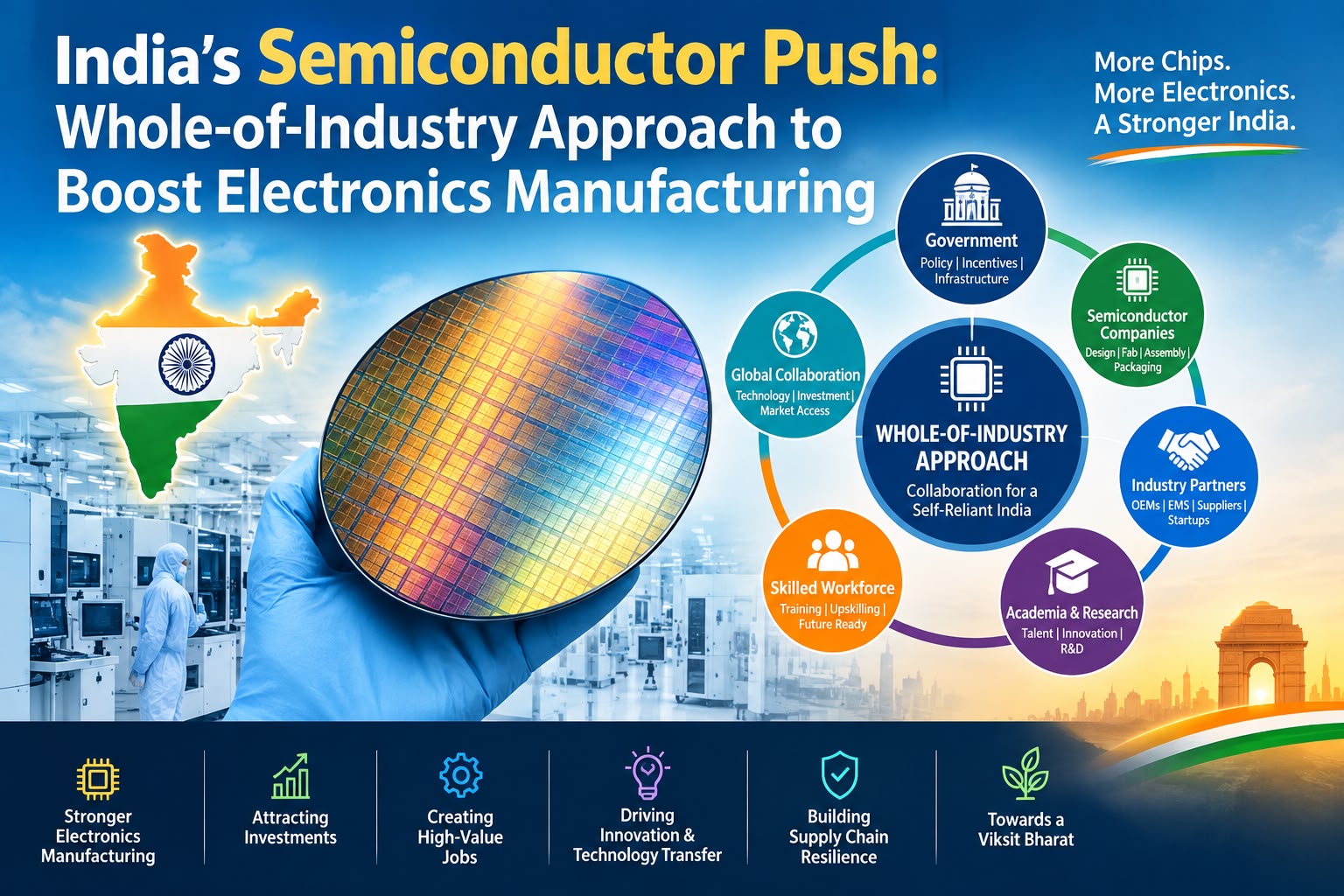
India’s Electronics and Semiconductor Push: Why a Whole-of-Industry Approach Matters
New Delhi: India is strengthening its ambitions to become a major global hub for electronics and semiconductor manufacturing, with the government and industry increasingly focusing on a coordinated “whole-of-industry” approach.
The approach aims to bring together semiconductor manufacturers, electronics companies, component suppliers, chip designers, research institutions, technology companies and industry associations to build a stronger domestic technology ecosystem.
The discussion gained prominence at SEMICON India 2026, where industry representatives highlighted the importance of collaboration across different segments of the semiconductor and electronics value chain.
India Moves Beyond Semiconductor Manufacturing
India's semiconductor ambitions are no longer limited to establishing chip fabrication facilities.
The broader objective is to develop an ecosystem covering the complete technology value chain — from chip design and semiconductor manufacturing to packaging, testing, electronics manufacturing and finished products.
This approach is often described as “Silicon to Systems”, connecting semiconductor capabilities with India's rapidly expanding electronics and technology industries.
A strong semiconductor ecosystem requires supporting industries such as semiconductor materials, manufacturing equipment, testing facilities, logistics, skilled manpower and research and development.
Industry Associations to Play a Greater Role
Industry associations representing different parts of India's technology sector are expected to play an increasingly important role in supporting this ecosystem.
Greater coordination between these organisations could help identify common challenges and create opportunities for collaboration in areas such as:
- Semiconductor manufacturing
- Electronics production
- Component manufacturing
- Chip design
- Research and development
- Skill development
- Supply-chain development
- Standards and certification
- Investment and infrastructure
The objective is to strengthen communication between different industry segments while allowing individual associations to continue focusing on their respective sectors.
SEMICON India 2026 Highlights India’s Growing Semiconductor Ecosystem
SEMICON India 2026 brought together companies and stakeholders from across the global semiconductor industry.
The event showcased developments in semiconductor manufacturing, chip design, advanced packaging, artificial intelligence, electronics manufacturing, research and development and skill development.
The participation of international companies also underlined the growing global interest in India's semiconductor and electronics market.
India's large domestic consumer market, expanding electronics manufacturing capabilities and policy support have created opportunities for companies looking to establish manufacturing and technology operations in the country.
Government Support for Semiconductor Manufacturing
The Indian government has introduced several initiatives to accelerate the development of the country's semiconductor ecosystem.
The India Semiconductor Mission (ISM) is supporting the development of semiconductor manufacturing, packaging, design and related capabilities.
The government's semiconductor programme is also intended to encourage private investment and establish domestic capabilities in strategically important areas.
According to government information, multiple semiconductor projects have been approved under the Semicon India Programme, with commercial manufacturing facilities beginning to become operational.
Why Electronics Manufacturing Is Important
Semiconductors are a fundamental component of modern electronic products.
They are used in smartphones, automobiles, electric vehicles, industrial equipment, telecommunications infrastructure, consumer electronics, medical devices and data centres.
As India's electronics manufacturing industry expands, domestic semiconductor capabilities could help create stronger links between chip manufacturing and the production of finished electronic products.
This could also support the development of domestic component suppliers and create opportunities for smaller companies and startups across the technology supply chain.
Opportunities for Indian Companies
The development of a semiconductor ecosystem could create opportunities beyond large semiconductor fabrication facilities.
Indian companies could participate in areas such as:
Chip Design:
India already has a large engineering and technology talent pool, creating opportunities in semiconductor design and intellectual property development.
Electronics Manufacturing:
Increasing electronics production could generate demand for domestic suppliers and contract manufacturers.
Components:
Resistors, capacitors, sensors, connectors, displays and other electronic components form an important part of the broader ecosystem.
Testing and Packaging:
Assembly, testing and packaging are critical stages between semiconductor manufacturing and finished electronic products.
Industrial Infrastructure:
Semiconductor facilities require specialised infrastructure, utilities, clean-room systems, logistics and engineering services.
Skill Development:
The expansion of the industry will increase demand for engineers, technicians and specialised semiconductor professionals.
The Road Ahead
India's semiconductor strategy is entering a phase in which the focus is increasingly shifting from individual projects to the development of a connected ecosystem.
A successful semiconductor industry requires cooperation between government agencies, manufacturers, technology companies, suppliers, research institutions, universities and industry associations.
The whole-of-industry approach seeks to create these connections and ensure that growth in semiconductor manufacturing is accompanied by growth in electronics, components, design, packaging, skills and supporting infrastructure.
For India, the long-term opportunity extends beyond manufacturing chips. The larger objective is to build a technology ecosystem capable of developing products and systems that can compete in domestic and international markets.
Key Takeaways
- India is pursuing a whole-of-industry approach for electronics and semiconductors.
- The focus is expanding from chip manufacturing to the broader Silicon-to-Systems ecosystem.
- Industry associations can help improve coordination across different technology sectors.
- Semiconductor development is closely linked with electronics, components, packaging and chip design.
- Government initiatives are supporting semiconductor manufacturing and related capabilities.
- The sector could create opportunities in manufacturing, design, testing, packaging, infrastructure and skill development.
- Strong collaboration across the value chain will be important for India's long-term semiconductor ambitions.
What's Hot
-

Asian Games 2026: India Wins Double Kabaddi Gold, Medal Tally Reaches 28
-

Trump Moves to Cancel Nearly Dollar 1 Billion in Congress-Approved Funding
-

PM Modi Calls Bhajan Clubbing “Spectacular”: What It Is All About
-

Tata Aeris Launch 2026: New Compact Sedan to Replace Tigor, Price, Features, Engine, CNG and EV Details
-
India’s Semiconductor Push: Whole-of-Industry Approach to Boost Electronics Manufacturing
-

National Film Awards 2026 Winners: Yami Gautam, Kartik Aaryan, Mammootty, Pushpa 2
-

PM Kisan 24th Installment Date 2026: When Will ?2,000 Be Credited?
-

Xi Jinping's US Visit: What It Means for the World Economy
-
ndia is rapidly expanding renewable energy, but transmission bottlenecks and limited storage are causing clean electricity to be curtailed. Here's what it means.
-

SEO Title: Mahindra Thar OG Launched at INR 10.32 Lakh: Price, Features & Specs