

Trump Moves to Cancel Nearly Dollar 1 Billion in Congress-Approved Funding
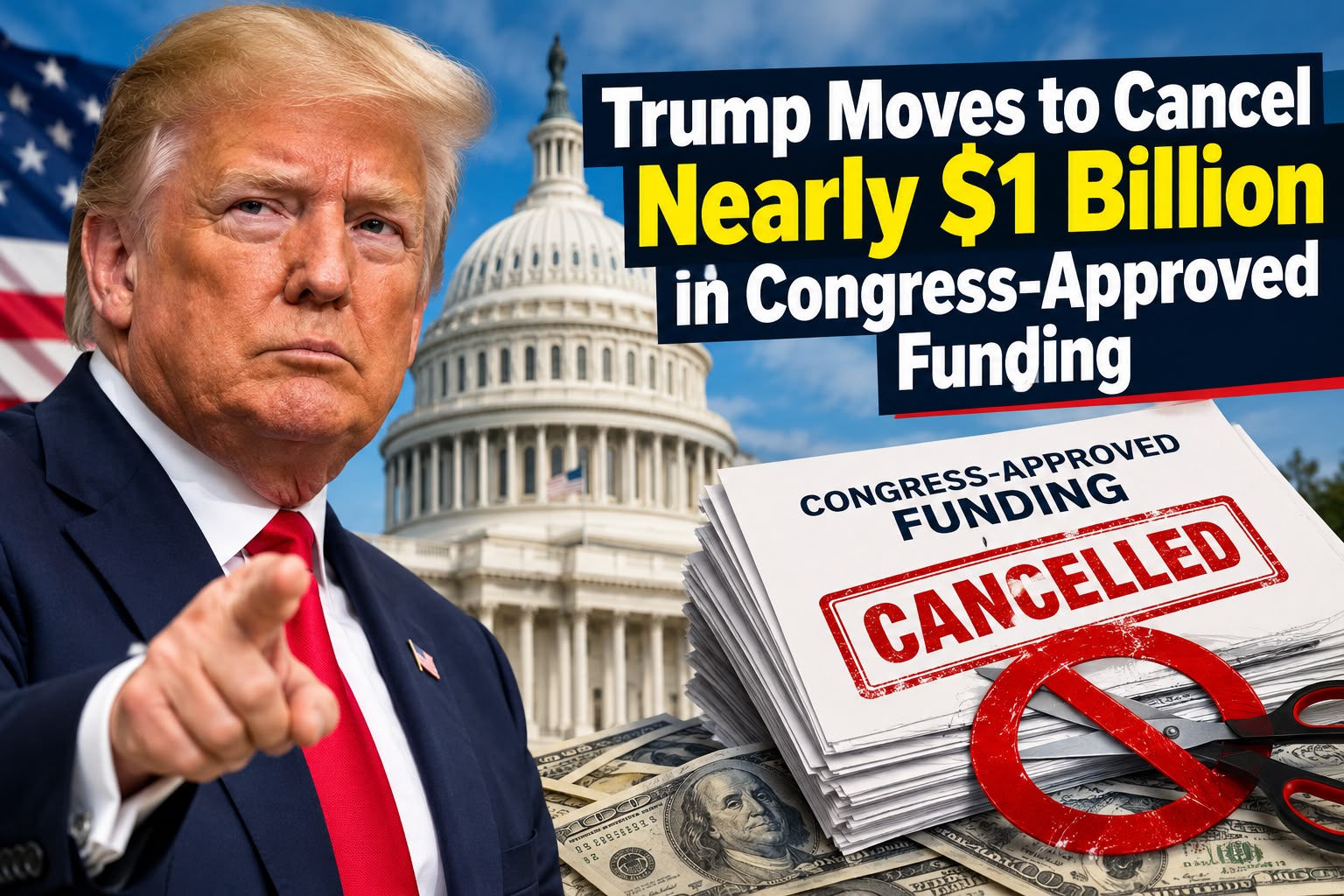
Washington, September 26, 2026: U.S. President Donald Trump’s administration has moved to cancel nearly Dollar 1 billion in federal funding that had been approved by Congress, opening a new political and constitutional debate over the president’s authority to control government spending.
The administration announced the move just days before the end of the U.S. federal fiscal year on September 30. The proposed cuts target hundreds of millions of dollars allocated to programs across several federal departments.
The White House has defended the decision as an effort to eliminate spending it considers unnecessary, wasteful or inconsistent with the administration’s priorities.
What Funding Is Being Targeted?
The proposed rescissions reportedly involve around Dollar 810 million in federal funding.
A substantial portion—approximately Dollar 567 million—is connected to programs administered by the U.S. Department of Health and Human Services, including services associated with refugee resettlement and assistance for unaccompanied migrant children.
The administration argues that changing conditions at the U.S.-Mexico border have reduced the need for some of these programs at their previous funding levels.
Other targeted funding involves programs under departments including:
- Department of Education
- Department of Commerce
- Department of Homeland Security
- Department of Housing and Urban Development
- Department of Justice
The affected programs cover areas including education, housing, refugee assistance and support for certain communities and organizations.
What Is a Pocket Rescission?
The latest move centers on a relatively unusual budget mechanism known as a “pocket rescission.”
Normally, when the president wants to cancel money that Congress has appropriated, Congress has an opportunity to consider the proposed rescission. A pocket rescission is designed around the timing of the congressional session and the end of the fiscal year.
The Trump administration submitted the proposed cancellations shortly before September 30, leaving lawmakers limited time to respond.
The administration argues that its action is permitted under existing federal law and is necessary to prevent taxpayer money from being spent on programs it considers inappropriate or no longer necessary.
Why Is Congress Concerned?
The decision has raised concerns among lawmakers because the U.S. Constitution gives Congress significant authority over federal spending.
Some members of Congress argue that the executive branch should not be able to effectively block funds that lawmakers have already approved through the appropriations process.
Republican Senator Susan Collins, chair of the Senate Appropriations Committee, has criticized the administration’s approach and raised concerns about Congress’s constitutional authority over federal spending.
Democratic lawmakers have also challenged the move, arguing that Congress approved the funding through the normal legislative process.
A Broader Fight Over Presidential Spending Power
The latest dispute is part of a broader conflict between the Trump administration and Congress over the president’s ability to control federal spending.
During Trump’s second term, the administration has pursued significant reductions in government spending and sought to review programs across the federal government.
A similar rescission strategy was used in 2025 involving billions of dollars in foreign-aid funding. The current action is different because a large portion of the latest proposed cuts concerns domestic programs.
That distinction could make the current dispute particularly important in determining the limits of presidential authority over domestic spending.
What Happens Next?
The timing of the announcement is crucial because the U.S. federal fiscal year ends on September 30.
Congress has limited time to respond to the proposed rescissions. Lawmakers could challenge the administration’s interpretation of federal spending law, while legal disputes could potentially move through the courts.
The outcome could have implications beyond the roughly Dollar 810 million currently involved.
At stake is a broader question about the balance of power between the White House and Congress: Can a president prevent Congress-approved funds from being spent when the administration believes those funds are unnecessary or inconsistent with its policies?
The answer could influence how federal appropriations are handled in future administrations.
Why This Matters for the U.S. Economy and Government
The immediate financial impact of the proposed cancellations is relatively small compared with the overall size of the U.S. federal budget. However, the significance of the move extends beyond the dollar amount.
Federal agencies, state governments, nonprofit organizations and other recipients depend on congressional appropriations to plan programs and budgets. Changes to previously approved funding can therefore affect government operations and create uncertainty for organizations relying on federal support.
At the same time, the administration argues that reviewing and cancelling unnecessary spending can help improve government efficiency and reduce taxpayer costs.
The debate is therefore not simply about Dollar 1 billion in spending. It also concerns the respective powers of the president and Congress over how taxpayer money is allocated and spent.
Key Takeaways
- The Trump administration is seeking to cancel approximately Dollar 810 million in previously approved federal funding.
- Around Dollar 567 million is linked to programs administered by the Department of Health and Human Services.
- Education, housing, commerce, homeland security and justice-related programs are also affected.
- The administration is relying on a “pocket rescission” approach.
- The move has triggered concerns among lawmakers over Congress’s constitutional spending authority.
- The September 30 fiscal-year deadline gives Congress limited time to respond.
- The dispute could ultimately become an important test of presidential authority over congressional appropriations.
What's Hot
-

Asian Games 2026: India Wins Double Kabaddi Gold, Medal Tally Reaches 28
-
Trump Moves to Cancel Nearly Dollar 1 Billion in Congress-Approved Funding
-

PM Modi Calls Bhajan Clubbing “Spectacular”: What It Is All About
-

Tata Aeris Launch 2026: New Compact Sedan to Replace Tigor, Price, Features, Engine, CNG and EV Details
-

India’s Semiconductor Push: Whole-of-Industry Approach to Boost Electronics Manufacturing
-

National Film Awards 2026 Winners: Yami Gautam, Kartik Aaryan, Mammootty, Pushpa 2
-

PM Kisan 24th Installment Date 2026: When Will ?2,000 Be Credited?
-
Xi Jinping's US Visit: What It Means for the World Economy
-

ndia is rapidly expanding renewable energy, but transmission bottlenecks and limited storage are causing clean electricity to be curtailed. Here's what it means.
-

SEO Title: Mahindra Thar OG Launched at INR 10.32 Lakh: Price, Features & Specs