

PM Modi’s 80th Independence Day Address: A New Roadmap for a Self-Reliant and Developed India
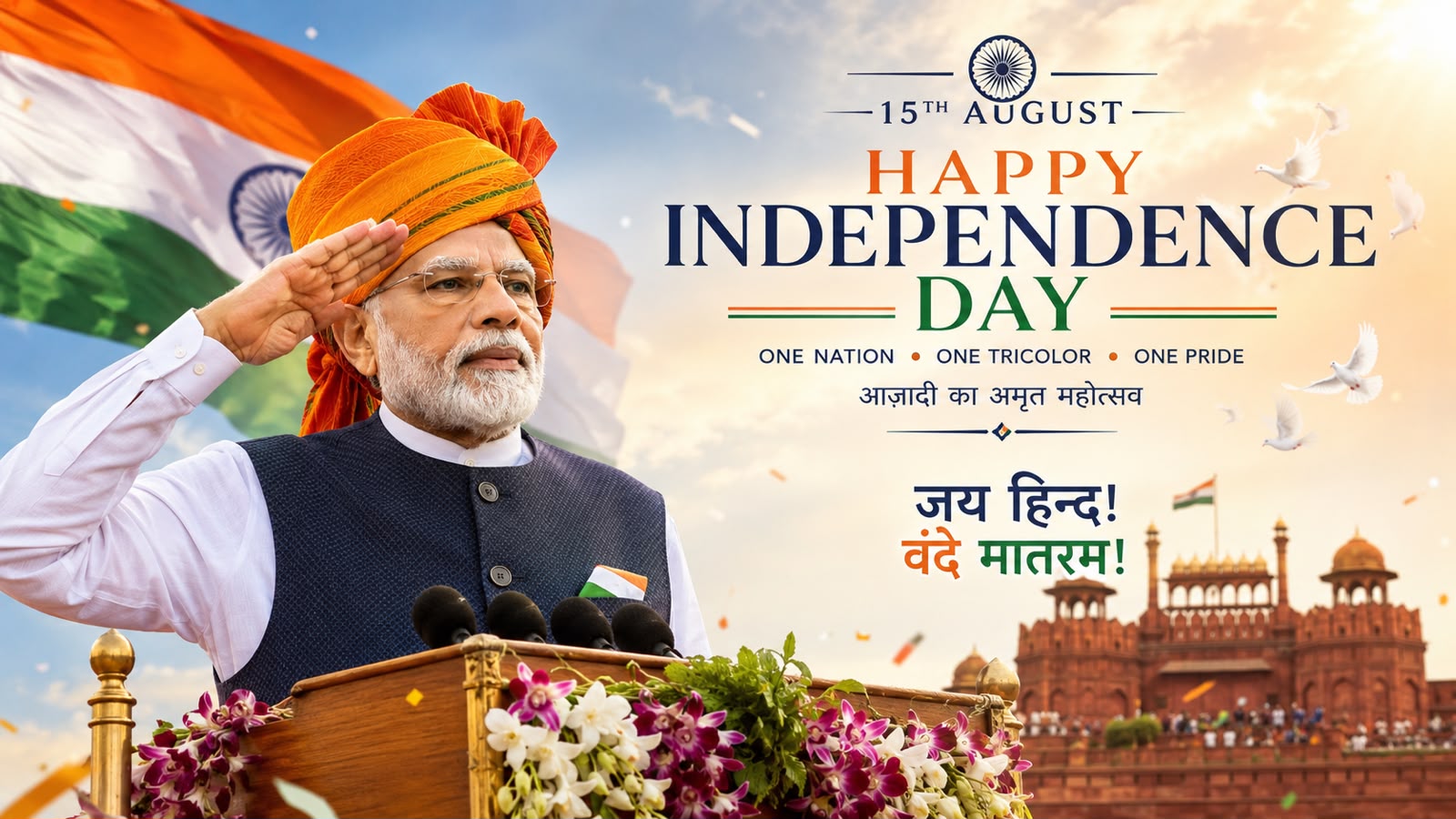
PM Modi’s 80th Independence Day Address: A New Roadmap for a Self-Reliant and Developed India
‘India Should No Longer Depend on Other Nations’: PM Modi Puts Self-Reliance, Semiconductors, Youth and Women at the Heart of Viksit Bharat
Prime Minister Narendra Modi’s 80th Independence Day address from the historic Red Fort presented a powerful vision for India’s journey towards Viksit Bharat 2047. The speech placed national self-reliance, technological capability, manufacturing, semiconductors, energy security, women’s participation and youth empowerment at the centre of India’s next phase of development.
From invoking Vande Mataram to highlighting India’s achievements and outlining future priorities, the Prime Minister’s address combined patriotism with a strong economic and strategic message: India must build the capabilities required to shape its own future rather than remain dependent on other nations.
Vande Mataram: Beginning the Journey with National Pride
PM Modi began his Independence Day message with a strong reference to Vande Mataram, connecting the present-day aspirations of India with the sacrifices and spirit of the freedom movement.
The emphasis carries special significance as India reflects on its journey through eight decades of Independence. The message was clear: the freedom achieved by previous generations must now be transformed into economic strength, technological capability and national confidence.
From political freedom to economic and technological freedom — India’s next journey is about building national capability.
Atmanirbhar Bharat: From Self-Reliance to Strategic Capability
One of the strongest themes of the address was the need for India to reduce excessive dependence on foreign countries.
The concept of Atmanirbhar Bharat is increasingly moving beyond the traditional idea of producing goods domestically. It now encompasses critical technologies, energy, defence, electronics, semiconductors, critical minerals and advanced manufacturing.
The objective is not isolation from the global economy. Instead, India aims to participate in global trade and supply chains from a position of greater strength.
The emerging model is:
Design in India → Manufacture in India → Innovate in India → Export from India → Compete Globally
This could become one of the defining economic themes of India's journey towards 2047.
Semiconductor Mission: Building India’s Technology Backbone
The Prime Minister’s emphasis on semiconductors highlights the growing strategic importance of India's electronics and technology ecosystem.
Semiconductors are the foundation of almost every modern industry, including:
- Automobiles and electric vehicles
- Smartphones and consumer electronics
- Artificial intelligence
- Telecommunications
- Defence systems
- Aerospace and space technology
- Data centres
- Industrial automation
- Renewable energy systems
India’s long-term semiconductor ambition therefore extends beyond chip manufacturing. It involves developing a complete ecosystem covering chip design, fabrication, packaging, testing, equipment, materials, electronics manufacturing and skilled talent.
A stronger semiconductor ecosystem can help India move from being primarily a major technology consumer and electronics assembler towards becoming a significant global technology and manufacturing hub.
Energy Security: A Critical Part of Self-Reliance
Energy independence is another important component of India's development strategy.
India’s economic growth requires reliable and affordable energy. Reducing excessive dependence on imported energy can strengthen the country’s economic resilience while supporting long-term industrial growth.
India is therefore building a diversified energy ecosystem involving:
Solar Energy | Wind Energy | Nuclear Power | Green Hydrogen | Battery Storage | Electric Mobility | Domestic Energy Resources
The energy transition also creates opportunities for Indian companies in renewable energy, power infrastructure, energy storage, EV charging and smart-grid technologies.
Women’s Empowerment and Political Representation
PM Modi called upon all political parties to cooperate in implementing women's reservation and ensuring women receive their rightful representation.
The broader message goes beyond political representation.
India cannot achieve its full economic potential without greater participation of women in every sector of society.
Women-led development can contribute to:
- Greater workforce participation
- Entrepreneurship
- Education and skills
- Financial inclusion
- Leadership
- Innovation
- Community development
- Stronger household incomes
The implementation of women's reservation can therefore become part of a much larger national objective: building an India where women are equal participants in decision-making and economic growth.
Youth Power: The Engine of Viksit Bharat
India's young population represents one of its greatest economic advantages.
But demographics alone cannot create development. The demographic dividend must be supported by education, skills, employment, entrepreneurship and access to new technologies.
The next generation of Indian youth will increasingly be required to work in areas such as:
- Artificial Intelligence
- Semiconductor technology
- Robotics
- Electronics
- EV technology
- Renewable energy
- Defence technology
- Software
- Advanced manufacturing
- Space technology
- Entrepreneurship
The objective should be to transform India's demographic advantage into a highly skilled and globally competitive workforce.
Manufacturing: Building the Foundation of a Strong Economy
The focus on manufacturing is critical to India's long-term economic ambitions.
A strong manufacturing ecosystem can create a powerful multiplier effect:
Investment → Factories → Jobs → Supplier Ecosystem → Exports → Higher Incomes → Economic Growth
India's opportunity is not limited to traditional manufacturing. The country can target high-value sectors such as electronics, semiconductors, EVs, batteries, defence equipment, renewable-energy equipment and advanced industrial products.
The goal is increasingly to make India a global manufacturing and export hub.
Critical Minerals: The Next Strategic Priority
The global technology race is also becoming a race for critical minerals.
Lithium, cobalt, nickel and rare-earth elements are increasingly important for batteries, electric vehicles, electronics, renewable energy, defence and advanced manufacturing.
Therefore, India's self-reliance strategy must cover the complete value chain:
Critical Minerals → Materials → Components → Manufacturing → Technology → Global Exports
Securing these supply chains will be essential for India's energy transition and technological ambitions.
Floods and Climate Resilience
While the Independence Day address focused strongly on India's future, the Prime Minister also addressed the immediate challenges faced by citizens affected by floods.
India's development journey must increasingly incorporate climate resilience.
Extreme weather events, flooding, heatwaves, droughts and landslides can affect agriculture, infrastructure, businesses and communities.
Future infrastructure therefore needs to be designed not only for growth but also for resilience:
Build → Protect → Adapt → Recover
Climate-resilient infrastructure will become increasingly important for India's cities, villages, roads, power networks and industrial systems.
EVs, Energy and the Future of Mobility
The vision of self-reliance has major implications for India's electric mobility revolution.
The future EV ecosystem is much larger than the vehicle itself.
It includes:
EVs + Batteries + Semiconductors + Charging Infrastructure + Power Networks + Software + Renewable Energy
India's continued expansion of EV charging infrastructure can therefore become an important part of the country's broader energy and mobility transformation.
Opportunities will emerge across:
- EV charging stations
- Charger installation
- Commissioning and testing
- O&M services
- Battery infrastructure
- Smart charging
- Energy management
- Renewable-powered charging
- Fleet charging
- Grid integration
Defence and Technology Self-Reliance
Technological self-reliance is also closely connected with national security.
Modern defence systems increasingly depend on advanced electronics, semiconductors, sensors, artificial intelligence, drones, communication systems and cybersecurity.
India's objective of strengthening domestic defence manufacturing therefore requires a broader technology ecosystem.
Technology sovereignty and national security are becoming increasingly interconnected.
The Bigger Vision: Viksit Bharat 2047
The various themes of the Independence Day address ultimately come together under one larger objective — Viksit Bharat 2047.
India's development journey is no longer only about increasing GDP.
It is about building a country that can:
- Manufacture at global scale
- Develop critical technologies
- Produce advanced electronics
- Secure energy supplies
- Strengthen defence capabilities
- Create high-quality employment
- Empower women
- Skill its youth
- Build resilient infrastructure
- Become a major global exporter
From “Make in India” to “Build in India”
The evolution of India's economic vision can be understood in three stages:
Yesterday
Import → Consume → Depend
Today
Manufacture → Build → Expand
Tomorrow
Design → Innovate → Manufacture → Export → Lead
This represents a deeper interpretation of Atmanirbhar Bharat.
India does not need to isolate itself from the world. Instead, it needs to become strong enough to compete with the world.
Conclusion: India’s Next Freedom Is Freedom from Dependency
PM Modi's 80th Independence Day address carries a larger message beyond individual announcements and government programmes.
The next chapter of India's development will be defined by capability, confidence and self-reliance.
From semiconductors and artificial intelligence to renewable energy, EVs, manufacturing, defence, critical minerals, women’s empowerment and youth development, India is attempting to build the foundations of a globally competitive economy.
The fundamental message is clear:
Political freedom gave India the right to shape its destiny. Economic and technological self-reliance can give India the power to shape its future.
As India moves towards Viksit Bharat 2047, the challenge is not merely to become a larger economy. The ambition is to become a country that designs, manufactures, innovates and leads from India for the world.
Jai Hind!
What's Hot
-

Asian Games 2026: India Wins Double Kabaddi Gold, Medal Tally Reaches 28
-

Trump Moves to Cancel Nearly Dollar 1 Billion in Congress-Approved Funding
-

PM Modi Calls Bhajan Clubbing “Spectacular”: What It Is All About
-
Tata Aeris Launch 2026: New Compact Sedan to Replace Tigor, Price, Features, Engine, CNG and EV Details
-
India’s Semiconductor Push: Whole-of-Industry Approach to Boost Electronics Manufacturing
-

National Film Awards 2026 Winners: Yami Gautam, Kartik Aaryan, Mammootty, Pushpa 2
-
PM Kisan 24th Installment Date 2026: When Will ?2,000 Be Credited?
-
Xi Jinping's US Visit: What It Means for the World Economy
-
ndia is rapidly expanding renewable energy, but transmission bottlenecks and limited storage are causing clean electricity to be curtailed. Here's what it means.
-

SEO Title: Mahindra Thar OG Launched at INR 10.32 Lakh: Price, Features & Specs