
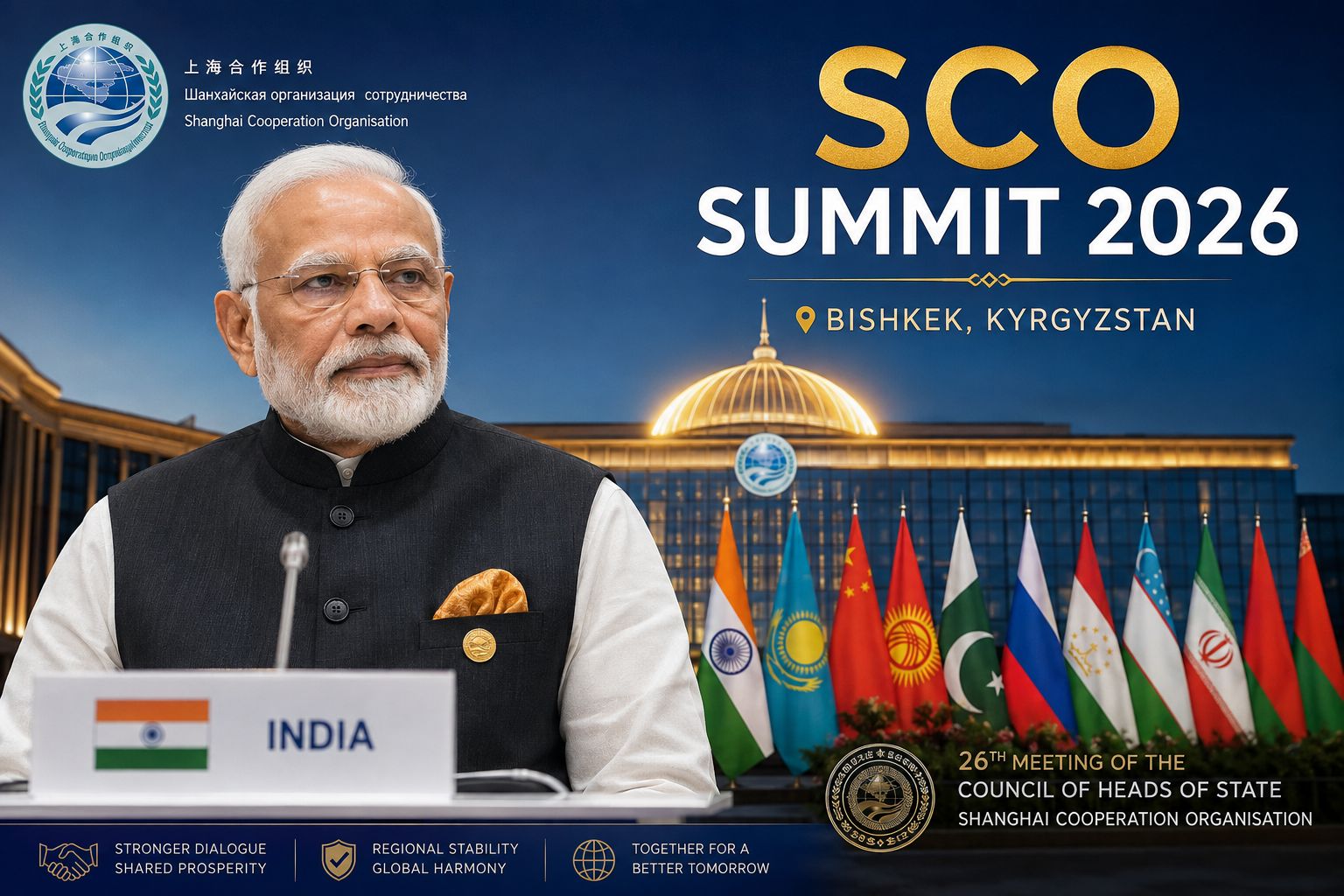
SCO Summit 2026: PM Modi Arrives in Bishkek, Holds Key Meeting With Iran President Pezeshkian
SCO Summit 2026: PM Modi Arrives in Bishkek, Holds Key Meeting With Iran President Pezeshkian
Bishkek, August 31, 2026: Prime Minister Narendra Modi has arrived in Bishkek, Kyrgyzstan, to attend the 26th Shanghai Cooperation Organisation (SCO) Summit, bringing together some of the world's most influential leaders at a time of heightened geopolitical tensions.
The SCO Summit is expected to focus on regional security, terrorism, cross-border threats, economic cooperation, energy security, transportation connectivity and digital cooperation. The ongoing conflict in West Asia is also likely to feature prominently in discussions among the participating leaders.
The summit brings together leaders including Russian President Vladimir Putin, Chinese President Xi Jinping, Iranian President Masoud Pezeshkian, Pakistan Prime Minister Shehbaz Sharif and Turkish President Recep Tayyip Erdogan, among others.
PM Modi Meets Iran President Pezeshkian
One of the key diplomatic developments surrounding the summit is the bilateral meeting between Prime Minister Narendra Modi and Iranian President Masoud Pezeshkian in Bishkek.
The meeting assumes particular significance against the backdrop of continuing tensions and conflict in West Asia. India and Iran have traditionally maintained close diplomatic engagement, with cooperation spanning energy, trade, connectivity and regional issues.
The Modi-Pezeshkian talks are being closely watched for their potential focus on regional stability, the West Asia crisis, humanitarian concerns, energy security and connectivity.
India has consistently advocated dialogue and diplomacy as the preferred approach to resolving conflicts and has sought to protect its strategic and economic interests while maintaining relations with all major players in the region.
Why the SCO Summit Is Important
The 26th SCO Summit comes at a crucial moment for global geopolitics. The organisation has emerged as an important platform for dialogue among countries spanning a large part of Eurasia.
For India, the summit provides an opportunity to engage simultaneously with Russia, China, Iran, Central Asian countries and other regional partners.
Key issues expected to dominate the discussions include:
- Regional peace and security
- Counter-terrorism and extremism
- Cross-border security threats
- Economic and trade cooperation
- Energy security
- Transport and logistics connectivity
- Digital cooperation
- Developments in West Asia
- Stability across the Eurasian region
West Asia Conflict May Take Centre Stage
The continuing conflict in West Asia has increased concerns about regional security, energy supplies and international trade routes.
For India, developments in the region are particularly important because of its substantial energy requirements, extensive trade links with West Asian countries and the presence of a large Indian community across the region.
Any prolonged instability could have consequences for global energy prices, shipping routes, supply chains and India's economic interests.
Against this backdrop, India's diplomatic engagement with Iran and other regional powers is expected to receive considerable attention.
PM Modi's Engagement With Russia and China
Another major focus of the SCO Summit will be India's engagement with Russia and China.
The presence of Prime Minister Modi alongside Russian President Vladimir Putin and Chinese President Xi Jinping makes the summit particularly significant from a strategic perspective.
India and Russia share long-standing relations in areas including defence, energy, trade and strategic cooperation. At the same time, India and China remain important economic powers despite differences over several bilateral and regional issues.
The SCO platform provides an opportunity for India to maintain dialogue with both countries while advancing its own strategic interests.
Pakistan's Presence Adds Another Dimension
Pakistan Prime Minister Shehbaz Sharif is also participating in the summit.
India-Pakistan relations remain sensitive, particularly over terrorism, cross-border security and regional stability. Although the SCO is primarily a multilateral platform, the presence of Indian and Pakistani leaders at the same summit is being closely watched.
India is expected to continue emphasising the need for strong international cooperation against terrorism and cross-border threats.
Central Asia: An Important Priority for India
The summit also highlights India's growing strategic engagement with Central Asia.
India has been seeking to strengthen political, economic and connectivity links with Central Asian nations. Improved transportation corridors and trade routes could provide India with greater access to markets across Eurasia.
Connectivity through Iran, including India's interest in the Chabahar route, is particularly important in this context as New Delhi seeks alternative and efficient routes to Central Asian and Eurasian markets.
Energy Security and Trade
Energy security is another major issue for India.
The geopolitical situation in West Asia, fluctuations in global energy markets and India's growing energy demand make stable energy supplies a critical national interest.
Discussions at the SCO could also explore greater economic cooperation, trade facilitation, transportation networks and energy partnerships among member states.
For India, stronger economic ties with Central Asia and other SCO members could open new opportunities for businesses, infrastructure development and connectivity projects.
Digital Cooperation and Emerging Technologies
Digital cooperation is also expected to receive increasing attention.
SCO members represent some of the world's largest and fastest-growing digital economies. Cooperation in areas such as digital infrastructure, cybersecurity, emerging technologies and digital connectivity could become an important part of the organisation's future agenda.
For India, which has positioned itself as a major digital economy, greater cooperation in digital technologies could create opportunities for innovation and international partnerships.
What the Summit Means for India
The Bishkek Summit provides India with a valuable diplomatic platform at a time when global alliances and strategic partnerships are undergoing significant changes.
New Delhi is attempting to maintain strategic autonomy while simultaneously strengthening relationships with Russia, the United States, Europe, Central Asia, Iran and other major global powers.
The SCO gives India an opportunity to engage with countries with which it has both areas of cooperation and differences.
Key Takeaways for India
1. Regional security: India can push for stronger cooperation against terrorism and cross-border threats.
2. West Asia: Engagement with Iran and other regional partners could help India protect its economic and strategic interests.
3. Energy: Stable energy supplies remain a key priority amid geopolitical uncertainty.
4. Connectivity: India can advance its connectivity objectives with Central Asia and Eurasia.
5. Trade: The summit could create opportunities for greater economic engagement with SCO members.
6. Strategic diplomacy: India's simultaneous engagement with Russia, China, Iran and Central Asian countries underlines its multi-alignment approach.
PM Modi's Bishkek Visit: What to Watch
The biggest developments to watch during the summit will be the leaders' bilateral meetings, the joint discussions on regional security and the outcome of conversations on the West Asia crisis.
Particular attention will remain on India's engagements with Iran, Russia, China and Central Asian countries, as these relationships have direct implications for India's security, energy and connectivity interests.
The summit also provides Prime Minister Modi with an opportunity to reinforce India's message that dialogue, diplomacy, counter-terrorism cooperation and respect for national interests are essential for long-term regional stability.
What's Hot
-
Asian Games 2026: India Wins Double Kabaddi Gold, Medal Tally Reaches 28
-

Trump Moves to Cancel Nearly Dollar 1 Billion in Congress-Approved Funding
-

PM Modi Calls Bhajan Clubbing “Spectacular”: What It Is All About
-

Tata Aeris Launch 2026: New Compact Sedan to Replace Tigor, Price, Features, Engine, CNG and EV Details
-

India’s Semiconductor Push: Whole-of-Industry Approach to Boost Electronics Manufacturing
-

National Film Awards 2026 Winners: Yami Gautam, Kartik Aaryan, Mammootty, Pushpa 2
-
PM Kisan 24th Installment Date 2026: When Will ?2,000 Be Credited?
-
Xi Jinping's US Visit: What It Means for the World Economy
-
ndia is rapidly expanding renewable energy, but transmission bottlenecks and limited storage are causing clean electricity to be curtailed. Here's what it means.
-

SEO Title: Mahindra Thar OG Launched at INR 10.32 Lakh: Price, Features & Specs