

Tata Motors Secures No. 2 Spot in India’s Passenger Vehicle Market with Record Market Share Gains
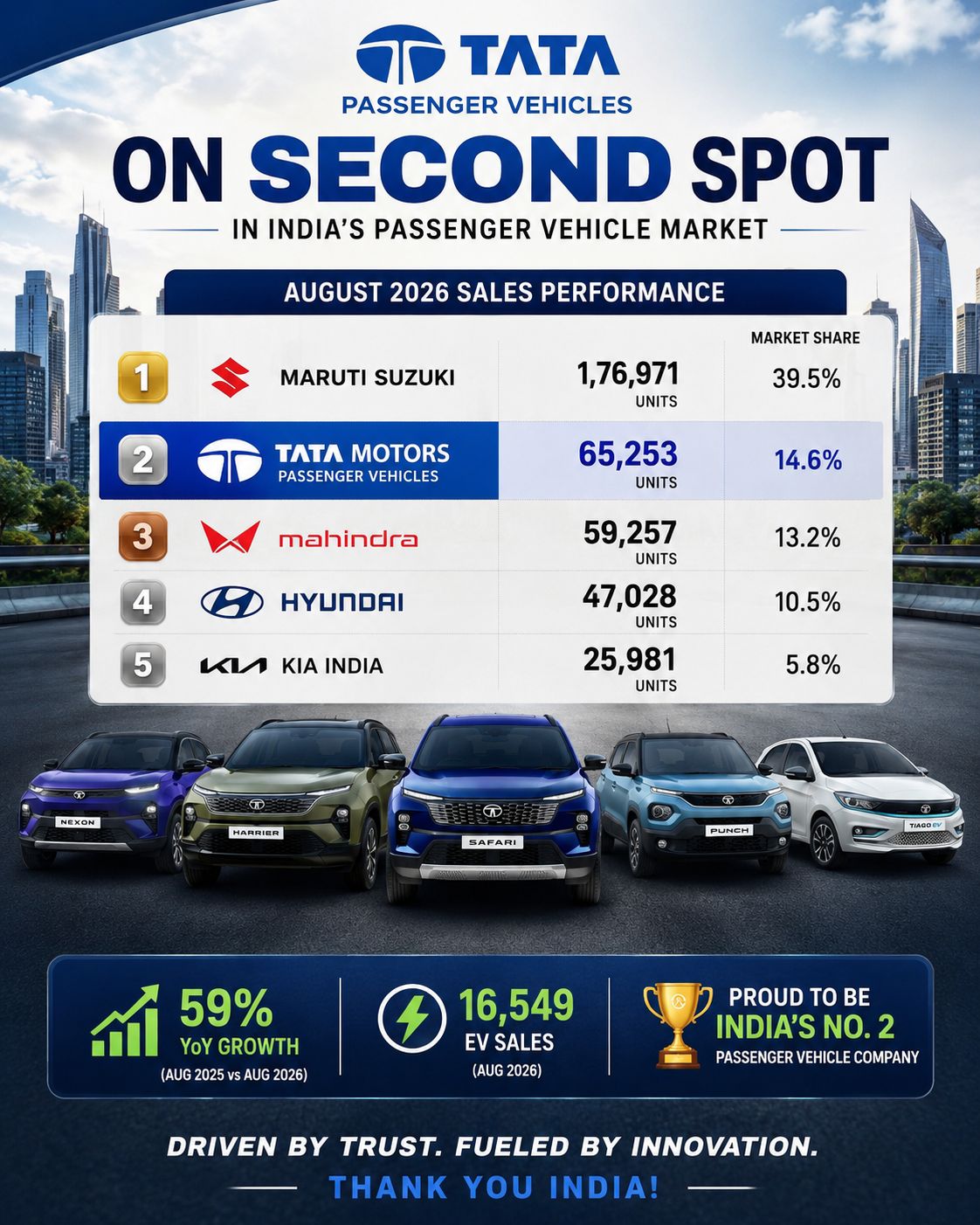
Tata Motors Secures No. 2 Spot in India’s Passenger Vehicle Market with Record Market Share Gains
Tata Motors has emerged as India’s second-largest passenger vehicle manufacturer during January–August 2026, registering strong growth and recording one of the biggest market-share gains among leading automakers.
Tata Motors has strengthened its position in India’s highly competitive passenger vehicle (PV) market, moving up to the No. 2 position during January–August 2026. The company’s strong performance has been driven by robust demand for its SUV portfolio, conventional passenger vehicles and a sharp recovery in electric vehicle (EV) sales.
According to vehicle registration data, Tata Motors recorded 494,370 passenger vehicle registrations during the first eight months of 2026, compared with 360,245 units during the corresponding period last year. This represents a 37.2% year-on-year growth, significantly ahead of the overall passenger vehicle market.
Tata Motors’ Market Share Rises to 14.29%
Tata Motors increased its passenger vehicle market share to 14.29% during January–August 2026, compared with 12.62% during the same period in 2025.
The gain is particularly significant because the overall Indian passenger vehicle market grew at a slower pace of around 21.2% during the period. Tata Motors' faster-than-market growth allowed it to overtake key competitors and strengthen its position among India's leading car manufacturers.
The company now trails only Maruti Suzuki, which continues to maintain a commanding lead in the Indian PV market.
Tata Motors Moves Ahead of Mahindra and Hyundai
Tata Motors’ rise to second place has changed the competitive ranking of India's passenger vehicle industry.
During January–August 2026, Maruti Suzuki maintained the No. 1 position with a market share of approximately 40.53%. Tata Motors followed with 14.29%, while Mahindra & Mahindra stood at 13.60%. Hyundai occupied the fourth position with 11.77%.
Leading Passenger Vehicle Manufacturers in India
|
Rank |
Manufacturer |
Market Share |
|
1 |
Maruti Suzuki |
40.53% |
|
2 |
Tata Motors |
14.29% |
|
3 |
Mahindra & Mahindra |
13.60% |
|
4 |
Hyundai |
11.77% |
|
5 |
Toyota |
6.90% |
|
6 |
Kia |
6.25% |
Tata Motors’ movement into second place is noteworthy as Mahindra had held the position during the comparable period last year.
SUV Portfolio Remains a Key Growth Engine
One of the major factors supporting Tata Motors’ growth is its strong SUV portfolio. Models such as the Punch, Nexon, Curvv and Harrier have helped the company strengthen its presence in one of India's fastest-growing passenger vehicle segments.
The popularity of compact and mid-size SUVs has significantly changed India's automotive market in recent years. Tata Motors has benefited from this trend by offering products across multiple price points and fuel technologies.
The company’s focus on safety, design, technology and multiple powertrain options has also helped attract a wider range of customers.
Strong Growth in Electric Vehicles
Tata Motors has also continued to maintain a strong presence in India's electric passenger vehicle market.
The company's EV registrations reportedly increased by around 85.5% year-on-year to 86,182 units during January–August 2026, compared with 46,456 units in the corresponding period last year.
Tata Motors' EV market share also remained above 40%, highlighting its continued leadership in India's electric passenger vehicle segment.
The company's EV portfolio includes models such as the Nexon.ev, Punch.ev, Curvv.ev and Harrier.ev, giving customers electric options across different vehicle categories.
Growth Is Not Dependent Only on EVs
While Tata Motors' EV performance has been impressive, its overall market-share gain has been supported by both electric and conventional vehicles.
The company's non-EV passenger vehicle registrations also increased strongly during the period. This broad-based growth is important because it indicates that Tata Motors is gaining customers across its entire passenger vehicle portfolio rather than relying on a single technology or segment.
This combination of internal-combustion-engine, CNG and electric models gives Tata Motors greater flexibility as India's automotive market continues to transition towards cleaner mobility.
Tata Motors Faces Strong Competition
Despite its impressive growth, Tata Motors operates in an increasingly competitive market.
Maruti Suzuki continues to dominate the industry, while Mahindra has established a strong position in SUVs. Hyundai and Toyota also remain important players, while new and established manufacturers are increasing their investments in electric vehicles.
Maintaining the No. 2 position will therefore depend on Tata Motors' ability to continue introducing attractive products, improve customer experience, maintain competitive pricing and expand its EV ecosystem.
What’s Ahead for Tata Motors?
Tata Motors' performance during the first eight months of 2026 represents a significant milestone for the company.
With passenger vehicle registrations growing faster than the overall market and EV sales recording substantial growth, Tata Motors enters the remainder of 2026 from a position of strength.
The company's expanding SUV range, growing EV portfolio and continued focus on new technologies could help it defend its newly acquired No. 2 position in India's passenger vehicle market.
Conclusion
Tata Motors' rise to the No. 2 position in India's passenger vehicle market marks a significant development in the country's automobile industry. With 494,370 registrations and a 14.29% market share during January–August 2026, the automaker has demonstrated strong momentum.
The company's combination of SUVs, conventional vehicles and electric models has created a diversified growth strategy. If this momentum continues, Tata Motors could remain one of the key challengers shaping India's passenger vehicle market in the years ahead.
What's Hot
-

Asian Games 2026: India Wins Double Kabaddi Gold, Medal Tally Reaches 28
-

Trump Moves to Cancel Nearly Dollar 1 Billion in Congress-Approved Funding
-

PM Modi Calls Bhajan Clubbing “Spectacular”: What It Is All About
-
Tata Aeris Launch 2026: New Compact Sedan to Replace Tigor, Price, Features, Engine, CNG and EV Details
-

India’s Semiconductor Push: Whole-of-Industry Approach to Boost Electronics Manufacturing
-

National Film Awards 2026 Winners: Yami Gautam, Kartik Aaryan, Mammootty, Pushpa 2
-

PM Kisan 24th Installment Date 2026: When Will ?2,000 Be Credited?
-

Xi Jinping's US Visit: What It Means for the World Economy
-
ndia is rapidly expanding renewable energy, but transmission bottlenecks and limited storage are causing clean electricity to be curtailed. Here's what it means.
-

SEO Title: Mahindra Thar OG Launched at INR 10.32 Lakh: Price, Features & Specs