

Apple CEOs Journey: From Steve Jobs to John Ternus — The Leaders Who Shaped Apple
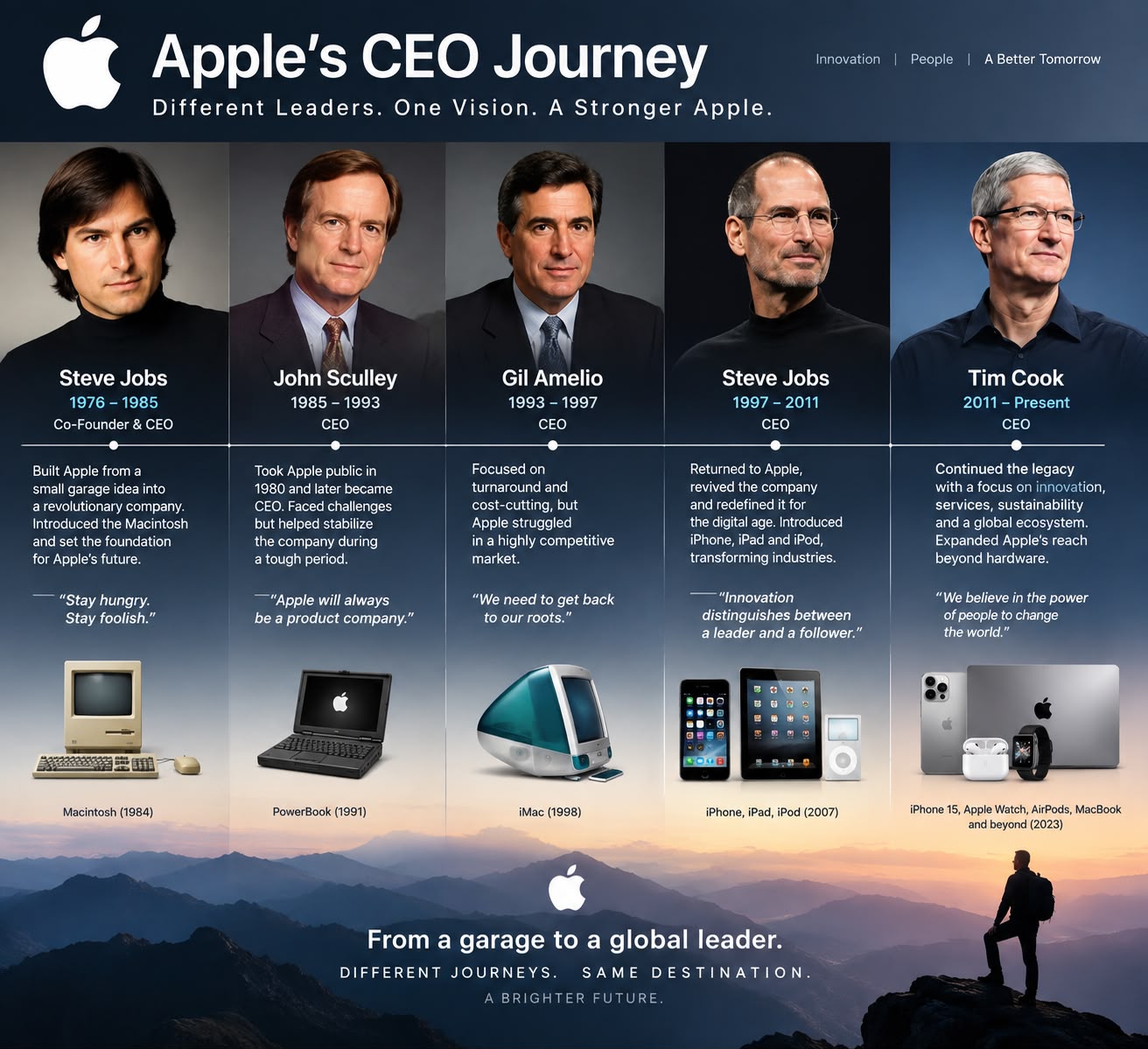
Apple was founded in 1976 by Steve Jobs, Steve Wozniak and Ronald Wayne. Over the following five decades, the company experienced periods of rapid growth, leadership battles, financial difficulties and extraordinary technological breakthroughs.
Today, Apple enters a new chapter under John Ternus, who became CEO on September 1, 2026, succeeding Tim Cook.
Apple’s CEO Journey at a Glance
|
CEO |
Tenure |
Major Era |
|
Michael Scott |
1977–1981 |
Apple’s early growth |
|
Mike Markkula |
1981–1983 |
Commercial expansion |
|
John Sculley |
1983–1993 |
Macintosh era |
|
Michael Spindler |
1993–1996 |
Competitive pressure |
|
Gil Amelio |
1996–1997 |
Crisis and restructuring |
|
Steve Jobs |
1997–2011 |
iMac, iPod, iPhone and iPad revolution |
|
Tim Cook |
2011–2026 |
Global expansion and services |
|
John Ternus |
2026–Present |
Hardware, AI and next-generation Apple |
Michael Scott: Apple’s First CEO
Michael Scott became Apple's first CEO in 1977, shortly after the company was incorporated.
Apple was still a young technology startup at the time, primarily focused on personal computers. Scott's leadership helped establish the foundations of Apple as a commercial organisation.
His tenure represents the company's formative years, when Apple was moving from a small Silicon Valley venture toward becoming a recognised computer manufacturer.
Mike Markkula: The Investor Who Helped Build Apple
Mike Markkula was one of Apple's earliest investors and an important figure in the company's development.
He became CEO in 1981 and helped Apple transition into a more professionally managed business.
Markkula had already provided crucial financial backing and business expertise to the young company. His involvement helped create a stronger organisational foundation for Apple's next stage of growth.
John Sculley: The Pepsi Executive at Apple
John Sculley became Apple's CEO in 1983 after being recruited from PepsiCo by Steve Jobs.
His arrival brought a strong marketing and business background to Apple. During his decade at the company, Apple continued expanding its Macintosh business.
However, the relationship between Sculley and Jobs eventually deteriorated. In 1985, Jobs left Apple following an internal power struggle.
Sculley's tenure continued for several years, but Apple later faced increasing competition and strategic challenges in the personal-computer market.
Michael Spindler: A Difficult Period for Apple
Michael Spindler became CEO in 1993.
Apple was facing significant pressure from competitors, particularly in the rapidly changing PC industry. The company struggled with product complexity, competition and questions about its long-term strategy.
Spindler's tenure lasted only a few years before he was replaced in 1996.
Gil Amelio: The CEO Who Helped Bring Jobs Back
Gil Amelio took over as Apple's CEO in 1996, when the company was going through one of the most challenging periods in its history.
One of the most consequential decisions during Amelio's tenure was Apple's acquisition of NeXT, the company founded by Steve Jobs after his departure from Apple.
The acquisition ultimately brought Jobs back to Apple.
Amelio left the company in 1997, paving the way for Jobs to regain control and begin one of the most remarkable corporate turnarounds in business history.
Steve Jobs: The Man Who Transformed Apple
Steve Jobs returned to Apple in 1997 and became the central figure in the company's dramatic turnaround.
His second tenure as CEO transformed Apple from a struggling computer company into a global technology powerhouse.
Under Jobs, Apple launched a series of products that changed entire industries.
iMac
The colourful iMac, launched in 1998, became a symbol of Apple's renewed focus on design and simplicity.
iPod
The iPod, introduced in 2001, transformed portable music and helped Apple establish itself beyond the traditional computer market.
iTunes
Apple's iTunes ecosystem changed how consumers purchased and managed digital music.
iPhone
The biggest turning point came in 2007 when Jobs introduced the first iPhone.
The combination of a touchscreen, mobile internet, software and Apple's distinctive design philosophy helped redefine the smartphone industry.
iPad
Apple expanded its product ecosystem again with the iPad in 2010, creating a new category between smartphones and traditional computers.
Jobs resigned as Apple's CEO in August 2011 and was succeeded by Tim Cook.
His legacy remains closely associated with Apple's philosophy of combining technology, design and simplicity.
Tim Cook: Building Apple Into a Global Giant
Tim Cook became Apple's CEO in August 2011 after previously serving as the company's Chief Operating Officer.
Cook's leadership style was significantly different from Jobs'.
While Jobs was known primarily as a product visionary, Cook was recognised for his expertise in operations, supply chains and global business management.
Under Cook, Apple expanded its ecosystem and strengthened its services business.
Major developments during his tenure included:
- Apple Watch
- AirPods
- Apple Pay
- Apple Music
- Apple TV+
- Apple Silicon
- Apple Vision Pro
- Expansion of Apple's Services business
One of Cook's most important technological moves was Apple's transition from Intel processors to its own Apple-designed silicon, beginning with the M1 chip in Macs.
Apple also significantly expanded its global manufacturing and supply-chain network during Cook's tenure.
Cook stepped down as CEO on September 1, 2026, becoming Apple's Executive Chairman.
John Ternus: Apple’s New CEO
John Ternus became Apple's CEO on September 1, 2026.
Before taking the top job, Ternus served as Apple's Senior Vice President of Hardware Engineering. He had spent approximately 25 years at Apple and played a major role in the development of the company's hardware products.
His experience includes work across Apple's major product categories, including the iPhone, iPad, Mac, AirPods and Apple Watch.
Ternus therefore represents an interesting shift for Apple: the company's CEO is coming directly from its hardware engineering leadership.
What Does John Ternus Inherit?
Ternus takes charge of an Apple that is vastly larger than the company Steve Jobs returned to in 1997.
But his challenges are also different.
Artificial Intelligence
AI is likely to be one of the biggest priorities of the Ternus era.
Apple faces intense competition from technology companies investing heavily in generative AI and AI-powered products and services.
The challenge for Ternus will be integrating AI into Apple's ecosystem while maintaining the company's emphasis on privacy, hardware-software integration and user experience.
The Next Big Product
Steve Jobs had the iPhone and iPad as transformational products.
Tim Cook expanded Apple's ecosystem and services.
Ternus now faces the question of what comes next.
Whether that comes through AI, new computing platforms, wearables or another product category could determine the next phase of Apple's growth.
Global Supply Chain
Apple also continues to manage one of the world's most complex technology supply chains.
Diversifying manufacturing and strengthening production networks outside China will remain important as Apple navigates geopolitical and economic changes.
Apple’s Leadership Evolution
Apple's CEO history tells a broader story about the evolution of the company.
Michael Scott and Mike Markkula helped establish the business.
John Sculley led Apple through the Macintosh era and its expansion.
Michael Spindler and Gil Amelio faced Apple's difficult years.
Steve Jobs returned and transformed the company through revolutionary products.
Tim Cook scaled Apple into a global ecosystem and services powerhouse.
John Ternus now begins the next chapter, with AI and new technology at the centre of the industry.
From Garage Startup to Technology Giant
Apple's leadership journey spans nearly five decades and demonstrates how different leadership styles can shape the same company.
Steve Jobs is remembered for his product vision and ability to create new categories. Tim Cook built on that foundation through operational excellence, global expansion and services.
John Ternus now inherits both legacies.
His success will ultimately depend on whether Apple can continue producing products and technologies that consumers consider essential while navigating the rapidly changing world of artificial intelligence.
From the early days of personal computers to the iPhone revolution and now the AI era, Apple's story continues to be defined by its leaders — and the technology they choose to build.
What's Hot
-

Asian Games 2026: India Wins Double Kabaddi Gold, Medal Tally Reaches 28
-

Trump Moves to Cancel Nearly Dollar 1 Billion in Congress-Approved Funding
-

PM Modi Calls Bhajan Clubbing “Spectacular”: What It Is All About
-
Tata Aeris Launch 2026: New Compact Sedan to Replace Tigor, Price, Features, Engine, CNG and EV Details
-

India’s Semiconductor Push: Whole-of-Industry Approach to Boost Electronics Manufacturing
-

National Film Awards 2026 Winners: Yami Gautam, Kartik Aaryan, Mammootty, Pushpa 2
-

PM Kisan 24th Installment Date 2026: When Will ?2,000 Be Credited?
-
Xi Jinping's US Visit: What It Means for the World Economy
-
ndia is rapidly expanding renewable energy, but transmission bottlenecks and limited storage are causing clean electricity to be curtailed. Here's what it means.
-

SEO Title: Mahindra Thar OG Launched at INR 10.32 Lakh: Price, Features & Specs