

BRICS Summit 2026: Who’s Attending, Why It Matters and India’s Role
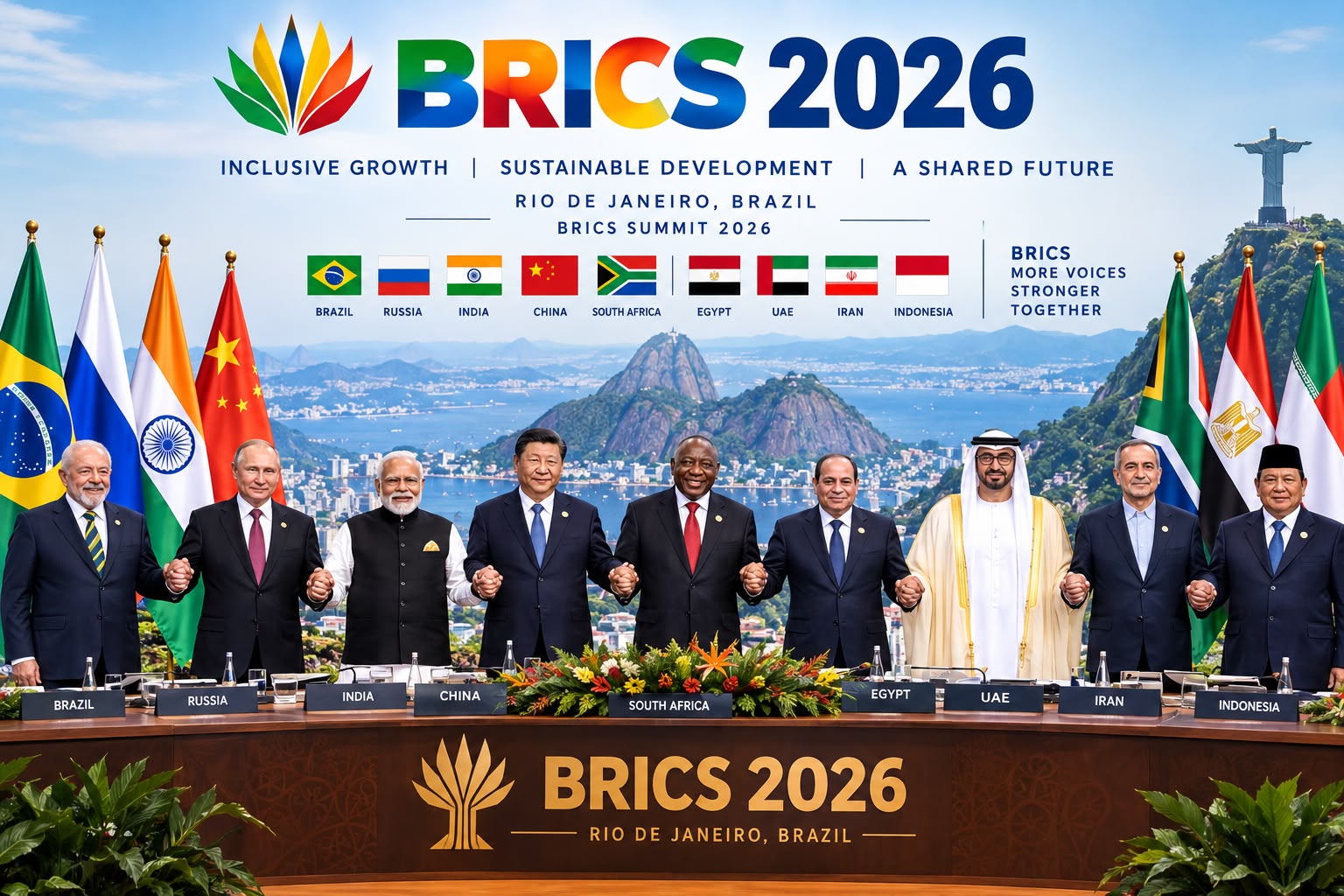
BRICS Summit 2026: India is set to host the 18th BRICS Summit in New Delhi on September 12–13, 2026, bringing together leaders of some of the world's most influential emerging economies. The summit comes at a crucial time for global politics, trade, energy security and the future of the Global South.
India assumed the BRICS Chairship on January 1, 2026, with the theme “Building for Resilience, Innovation, Cooperation and Sustainability.” The year also marks two decades since BRICS was formally established.
What is BRICS?
BRICS began as a grouping of Brazil, Russia, India and China, with South Africa joining later. The grouping has since expanded significantly and now includes 11 member countries.
The current BRICS members are:
- Brazil
- Russia
- India
- China
- South Africa
- Egypt
- Ethiopia
- Iran
- United Arab Emirates
- Saudi Arabia
- Indonesia
The expanded grouping has emerged as an important platform for economic cooperation and dialogue among developing and emerging economies.
Who is expected at the BRICS Summit 2026?
The New Delhi summit is expected to attract several major world leaders.
Prime Minister Narendra Modi will host the summit as India holds the BRICS Chairship.
Chinese President Xi Jinping is expected to attend, making his possible visit to India particularly significant for bilateral relations. His participation could provide an opportunity for India and China to discuss trade, investment, regional stability and other areas of cooperation.
Russian President Vladimir Putin is also expected to participate. Russia remains an important member of BRICS and a long-standing strategic partner of India.
Iranian President Masoud Pezeshkian is also expected to be part of the summit, adding importance to discussions surrounding energy, trade and developments in West Asia.
Other BRICS leaders and representatives from partner countries are also expected to participate in summit-related meetings and outreach sessions.
Why is the 2026 BRICS Summit important?
BRICS has become increasingly important because of the economic and demographic weight of its members.
The expanded grouping represents a significant share of the world's population and global economic activity. Its growing membership has also increased its potential influence on issues ranging from international trade and finance to energy and climate policy.
The 2026 summit is expected to focus on several key areas:
- Global economic cooperation
- International trade and investment
- Financial and payment systems
- Energy security
- Artificial intelligence and digital technology
- Climate change and sustainability
- Infrastructure development
- Supply-chain resilience
- Global health
- Cooperation among Global South nations
India's role in BRICS 2026
India's leadership of BRICS comes at a particularly important geopolitical moment.
New Delhi is expected to focus on making BRICS a more practical platform for economic and technological cooperation while strengthening the voice of developing countries in global institutions.
India has traditionally maintained a policy of strategic autonomy, maintaining relationships with both Western countries and major emerging powers such as Russia and China.
This approach is likely to influence India's BRICS agenda.
Rather than positioning BRICS purely as a counterweight to the West, India is expected to promote cooperation in areas where member countries share common interests.
India-China relations in focus
One of the biggest diplomatic talking points surrounding the summit will be the possible meeting between Narendra Modi and Xi Jinping.
India-China relations have experienced tensions in recent years, particularly because of border disputes. However, both countries have also been working towards stabilising bilateral relations.
A high-level interaction during the BRICS Summit could therefore attract considerable international attention.
Trade, investment, border stability, technology and regional security could feature prominently in discussions between the two sides.
BRICS and the future of global finance
Another major issue expected to feature prominently is reform of the international financial system.
BRICS members have increasingly discussed ways to improve cross-border payments and expand the use of national currencies in international trade.
The idea of reducing dependence on traditional financial systems has attracted attention, although members have different approaches to the issue.
India is likely to favour a practical approach focused on improving payment connectivity and facilitating trade rather than immediately pursuing a common BRICS currency.
Global South takes centre stage
One of India's major priorities is expected to be strengthening cooperation among countries of the Global South.
India has repeatedly advocated greater representation for developing nations in global institutions such as the United Nations, International Monetary Fund and World Bank.
The BRICS platform gives New Delhi an opportunity to push this agenda alongside other emerging economies.
Issues such as development finance, food security, energy access, technology and climate financing could therefore receive significant attention.
Artificial Intelligence and technology
Technology is another area where India could play a major role.
With India's experience in digital public infrastructure and its growing technology ecosystem, New Delhi is expected to promote greater cooperation among BRICS countries in areas such as:
- Artificial intelligence
- Digital public infrastructure
- Cybersecurity
- Fintech
- Digital payments
- Emerging technologies
- Technology-enabled development
AI governance could become particularly important as governments around the world debate how to balance innovation with security, privacy and responsible use.
Energy security and supply chains
Energy will remain another key priority for the expanded BRICS grouping.
Several BRICS members are major producers or consumers of oil, gas and other energy resources. Greater cooperation could help members address energy security while navigating the transition towards cleaner energy.
Global supply-chain disruptions have also highlighted the importance of diversification and resilience.
India is expected to advocate stronger cooperation in logistics, infrastructure, transportation and trade connectivity.
The challenge for BRICS
Despite its growing influence, BRICS faces a major challenge: its members do not always agree on geopolitical issues.
The grouping includes countries with very different political systems, economic priorities and foreign-policy interests.
Differences between India and China, Russia's relationship with Western countries, tensions in West Asia and disagreements over global trade could make consensus difficult.
India's challenge as Chair will therefore be to find common ground among members while keeping the organisation focused on practical cooperation.
What to watch at the New Delhi Summit
Several developments could emerge as major talking points during the summit:
Modi-Xi engagement: The possible meeting between the Indian and Chinese leaders could attract global attention.
India-Russia ties: Discussions between Modi and Putin are likely to focus on strategic, economic and energy cooperation.
Global financial reforms: BRICS could discuss ways to improve cross-border payments and financial cooperation.
AI and digital cooperation: India could push for greater collaboration in emerging technologies.
Global South agenda: Development, climate finance and infrastructure could receive greater emphasis.
West Asia: The ongoing conflicts and regional instability could feature prominently in discussions.
Why BRICS matters for India
For India, BRICS provides a platform to simultaneously pursue economic interests, strengthen diplomatic relationships and promote the priorities of developing nations.
Hosting the summit also gives India an opportunity to showcase its growing role in global diplomacy.
The country's position between major geopolitical blocs makes its BRICS leadership particularly significant. India can cooperate with Russia and China within BRICS while continuing its partnerships with the United States, Europe, Japan, Australia and other countries.
This balancing approach reflects India's broader foreign-policy strategy of maintaining strategic autonomy.
Bottom Line
The BRICS Summit 2026 in New Delhi is more than another international leaders' meeting. It comes at a time when the global economic and geopolitical order is undergoing significant change.
With an expanded membership, growing economic influence and a stronger focus on the Global South, BRICS is seeking to establish a larger role in international affairs.
For India, the summit represents an opportunity to shape that evolution.
The key question will be whether India can use its 2026 Chairship to turn BRICS' growing size and influence into practical cooperation on trade, technology, finance, energy and sustainable development.
As world leaders gather in New Delhi, India's message is likely to be clear: BRICS should be a platform for cooperation, development and a stronger voice for the Global South—not simply another arena for geopolitical confrontation.
What's Hot
-

Asian Games 2026: India Wins Double Kabaddi Gold, Medal Tally Reaches 28
-

Trump Moves to Cancel Nearly Dollar 1 Billion in Congress-Approved Funding
-

PM Modi Calls Bhajan Clubbing “Spectacular”: What It Is All About
-

Tata Aeris Launch 2026: New Compact Sedan to Replace Tigor, Price, Features, Engine, CNG and EV Details
-

India’s Semiconductor Push: Whole-of-Industry Approach to Boost Electronics Manufacturing
-

National Film Awards 2026 Winners: Yami Gautam, Kartik Aaryan, Mammootty, Pushpa 2
-

PM Kisan 24th Installment Date 2026: When Will ?2,000 Be Credited?
-
Xi Jinping's US Visit: What It Means for the World Economy
-
ndia is rapidly expanding renewable energy, but transmission bottlenecks and limited storage are causing clean electricity to be curtailed. Here's what it means.
-

SEO Title: Mahindra Thar OG Launched at INR 10.32 Lakh: Price, Features & Specs