

India Extreme Poverty Falls to 2.6% in 2023 From 27.1% in 2011: World Bank
India Economy | Poverty Reduction | World Bank Report | November 3, 2026
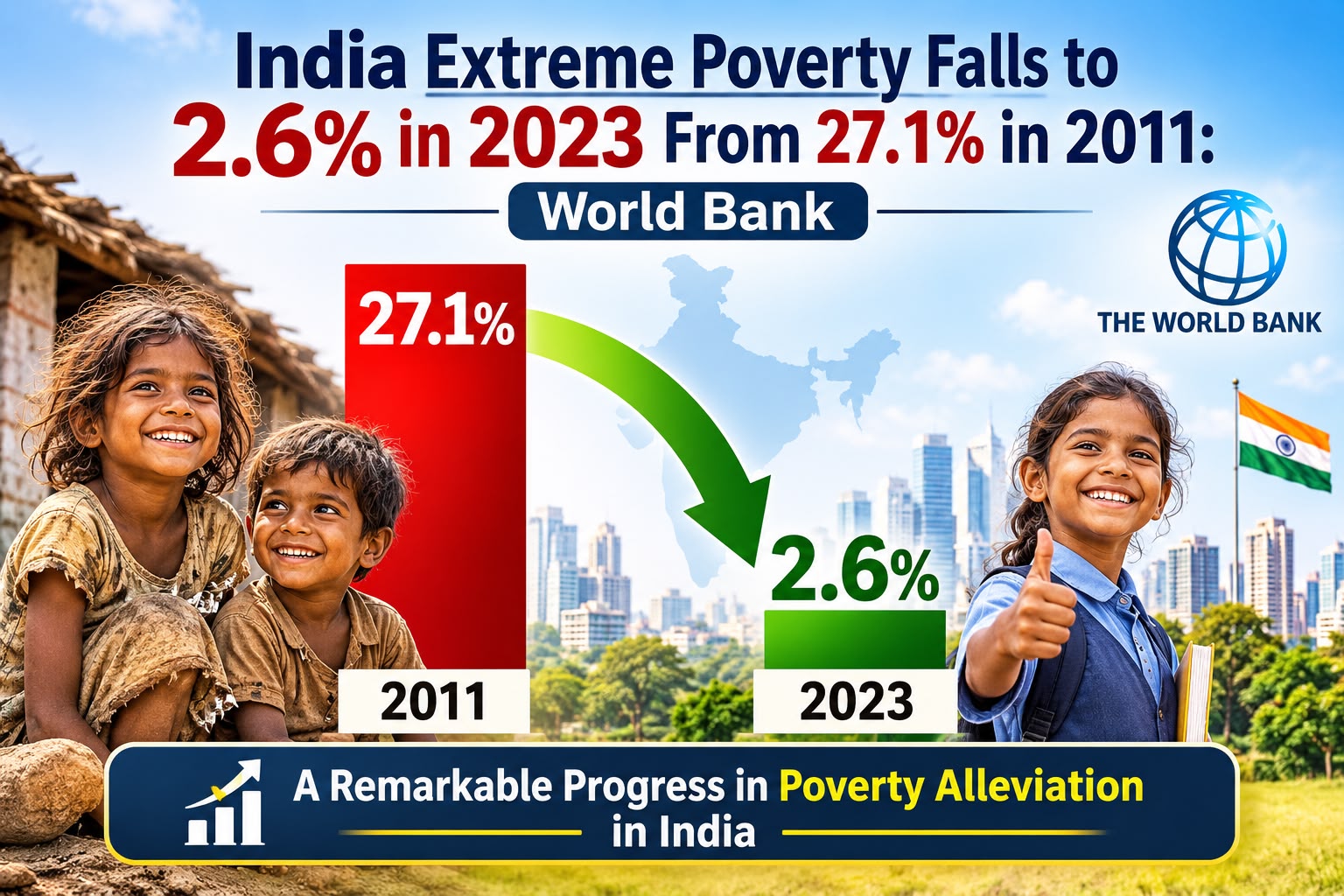
India has achieved a significant milestone in poverty reduction, with the country's extreme poverty rate declining from 27.1% in 2011 to just 2.6% in 2023, according to the World Bank's October 2026 Poverty and Equity Brief.
The latest report highlights the scale of India's economic and social transformation over the past 12 years. It estimates that approximately 496 million people, equivalent to 49.6 crore, moved above the World Bank's lower-middle-income poverty threshold during this period.
The report describes India's poverty reduction as one of the fastest declines in the world. Improvements in household consumption, rising employment, particularly among women, and expanded social welfare support have contributed to this progress.
However, the findings also highlight several challenges. Income inequality, unemployment among young people, regional economic disparities and the availability of quality employment remain important concerns for India's future development.
Key Highlights: World Bank Poverty Report 2026
Here are the major findings from the latest World Bank report:
- India's extreme poverty rate declined from 27.1% in 2011 to 2.6% in 2023.
- Approximately 49.6 crore people moved above the lower-middle-income poverty threshold.
- Poverty under the $4.20-per-day benchmark declined from 57.7% to 16.1%.
- Rural poverty declined faster than urban poverty, narrowing the rural-urban gap.
- Employment increased by approximately 13.4 crore people between 2017 and 2023.
- Rising participation of rural women in paid employment contributed to employment growth.
- Median earnings among the top 10% of workers remained approximately 13 times higher than those of the bottom 10%.
- Around 57% of India's remaining poor population is concentrated in a geographical belt stretching from Uttar Pradesh to West Bengal.
1. How Much Has Extreme Poverty Declined in India?
The most significant finding of the World Bank report is the reduction in the proportion of Indians living in extreme poverty.
In 2011, approximately 27.1% of India's population was living below the international extreme-poverty threshold. By 2023, this figure had dropped to 2.6%.
This represents a reduction of 24.5 percentage points in the extreme poverty rate.
The decline is particularly important considering India's population size. Even a relatively small percentage of people living in poverty can represent millions of households.
The report also highlights a substantial reduction in broader poverty levels.
According to the World Bank, the percentage of people living below the lower-middle-income poverty threshold of $4.20 per day declined from 57.7% in 2011 to 16.1% in 2023.
This translates into an estimated 496 million people moving above that poverty threshold.
India's Poverty Reduction: 2011 vs 2023
|
Poverty Indicator |
2011 |
2023 |
|
Extreme poverty ($3/day) |
27.1% |
2.6% |
|
Lower-middle-income poverty ($4.20/day) |
57.7% |
16.1% |
Source: World Bank, October 2026 Poverty and Equity Brief. Figures use 2021 Purchasing Power Parity (PPP).
It is important to understand that these are two different poverty measurements. The 496 million figure relates to the broader $4.20 threshold, not exclusively to people who escaped extreme poverty.
2. What Does the World Bank Mean by Extreme Poverty?
The World Bank uses international poverty lines to compare living standards across different countries.
For its latest assessment, the World Bank uses two important benchmarks:
Extreme poverty: $3 per person per day
This threshold identifies people living below an internationally comparable minimum consumption level. It is used to assess the most severe form of monetary poverty.
Lower-middle-income poverty: $4.20 per person per day
This is a broader benchmark designed for countries classified as lower-middle-income economies. It includes households that may have moved above extreme poverty but still face significant financial vulnerability.
Both thresholds are based on 2021 Purchasing Power Parity (PPP).
PPP adjusts for differences in the cost of living between countries. Therefore, $3 or $4.20 should not be interpreted as a direct conversion into Indian rupees at the prevailing foreign exchange rate.
The distinction is important because a household can move above the extreme-poverty threshold while continuing to face difficulties related to healthcare, education, housing and financial security.
3. Why Has Poverty Declined in India?
The World Bank attributes India's poverty reduction to a combination of economic growth, employment expansion and social welfare support.
A. Growth in Household Consumption
An increase in household consumption has been one of the major contributors to improved living standards.
When families have greater purchasing power, they can spend more on food, clothing, education, healthcare, transport and other essential requirements.
The World Bank's analysis indicates that strong consumption growth contributed significantly to the decline in monetary poverty.
B. Increasing Employment Opportunities
Employment growth has played an important role in improving household incomes.
The report estimates that employment increased by approximately 134 million people between 2017 and 2023.
This increase was nearly twice the growth in India's working-age population.
An increase in the number of employed household members can improve family income and reduce dependence on a single earning member.
However, the quality and productivity of these jobs remain important considerations.
C. Increasing Participation of Women in Employment
One of the notable findings of the report is the contribution of rural women to employment growth.
More women entering paid employment has increased the number of income earners in many households.
Women's participation in economic activities can improve household financial security and contribute to spending on children's education, healthcare and other essential needs.
However, the next challenge is ensuring access to stable employment, fair wages and better working conditions.
D. Government Welfare and Food Subsidies
Government social welfare programmes have also contributed to poverty reduction.
Expanded social transfers, particularly food subsidies, have helped economically vulnerable households manage essential expenses.
Programmes related to food security, rural employment, housing, sanitation and access to basic services have supported improvements in living conditions.
The impact of these initiatives should be considered alongside broader economic growth and improvements in employment.
4. Rural vs Urban Poverty: Which Areas Have Improved More?
The World Bank report indicates that poverty has declined across both rural and urban India.
However, rural areas have recorded a faster reduction under the lower-middle-income poverty benchmark.
Lower-middle-income poverty rate
|
Area |
2011 |
2023 |
|
Rural India |
64.9% |
19.3% |
|
Urban India |
39.7% |
8.6% |
The rural poverty rate declined by 45.6 percentage points, while urban poverty declined by 31.1 percentage points.
This indicates that the gap between rural and urban poverty has narrowed considerably.
Rural households have benefited from improvements in consumption, employment and access to welfare support. Nevertheless, rural communities continue to face challenges related to agricultural productivity, non-farm employment opportunities and access to higher-paying jobs.
The figures also show that poverty reduction is not limited to major cities. Economic improvements in villages and smaller towns have an important role in India's overall development.
5. How Many People Have Moved Above the Poverty Line?
One of the most widely discussed findings is the estimated 496 million people who moved above the lower-middle-income poverty line between 2011 and 2023.
That is approximately 49.6 crore people.
To understand the scale, this figure is larger than the population of many countries.
The decline from 57.7% to 16.1% under the $4.20-per-day threshold demonstrates the scale of the improvement in household consumption.
However, moving above an international poverty line does not automatically mean that a family has become financially secure.
Many households remain vulnerable to unexpected medical expenses, unemployment, inflation and other financial shocks.
Therefore, sustainable poverty reduction requires not only higher consumption but also stable income, savings, productive employment and access to essential public services.
6. Employment Growth: A Major Driver of India's Progress
The World Bank's report highlights the increase of approximately 13.4 crore employed people between 2017 and 2023.
This employment expansion was particularly influenced by rural women entering paid work.
A higher number of earning members can improve household financial stability and increase economic participation.
However, the report also identifies concerns regarding employment quality.
Real earnings remained broadly unchanged, while a significant portion of employment growth was concentrated in relatively low-productivity activities.
Youth unemployment also increased from 14.6% to 15.9% between the first quarters of FY2025-26 and FY2026-27, with particular concerns relating to rural young women.
This highlights an important difference between creating employment and creating productive, well-paying employment.
India's future economic progress will depend on generating opportunities in manufacturing, infrastructure, technology, services and other sectors that can provide sustainable income growth.
7. Income Inequality Remains a Major Challenge
Despite the reduction in extreme poverty, the World Bank has highlighted significant differences in earnings between India's highest-paid and lowest-paid workers.
According to the report, median earnings among the top 10% of workers were approximately 13 times higher than those of the bottom 10% in 2023.
This indicates that the benefits of economic growth are not distributed equally across all sections of society.
For example, a household earning enough to move above the international poverty line may still struggle to afford quality private education, healthcare, housing or long-term financial security.
India therefore faces two related but different challenges:
- Reducing the number of people living below international poverty thresholds.
- Ensuring that economic opportunities and income growth reach a wider section of the population.
Improving public education, healthcare, vocational training and access to productive employment will be important in addressing these challenges.
8. Uttar Pradesh to West Bengal: The Region That Still Needs Attention
Another important observation in the World Bank report concerns the geographical concentration of poverty.
Around 57% of India's remaining poor population lives in a contiguous geographical belt extending from Uttar Pradesh to West Bengal.
This highlights the importance of economic development in eastern and northern India.
States in this region need greater opportunities in:
- Manufacturing and industrial development.
- Rural infrastructure and connectivity.
- Agricultural productivity and food processing.
- Skill development and vocational education.
- Small businesses and entrepreneurship.
- Healthcare and educational infrastructure.
- Formal employment and higher-productivity services.
For states such as Uttar Pradesh, Bihar, Jharkhand and West Bengal, creating sustainable employment opportunities will be particularly important for the next phase of poverty reduction.
Economic growth in these regions can also help reduce migration pressures and encourage local entrepreneurship.
9. What Does This Mean for India's Economy?
The reduction in extreme poverty has implications beyond household income. It can influence India's consumption market, investment environment and long-term economic development.
A. Expansion of the Consumer Market
As household purchasing power improves, demand for essential goods, automobiles, electronics, consumer products and services can increase.
A larger section of the population participating in the formal consumer economy can create new opportunities for domestic businesses.
B. Growth in Rural Markets
Rural India represents a significant opportunity for companies operating in agriculture, retail, banking, telecommunications, automobiles and consumer goods.
Improved household consumption can encourage businesses to expand distribution networks and invest in smaller towns and villages.
C. Financial Inclusion
As more households participate in economic activities, demand for banking, insurance, digital payments, credit and savings products can increase.
Financial inclusion can also help households manage unexpected expenses and build long-term financial security.
D. Infrastructure and Energy Development
Reliable electricity, roads, transport, digital connectivity and access to essential services are important for improving economic opportunities.
Continued infrastructure investment can connect rural communities with markets, employment opportunities and public services.
E. Opportunities for Small Businesses
Improving household purchasing power can support local entrepreneurs, service providers, manufacturers and small businesses.
However, businesses will need to focus on affordability, regional demand and employment generation to benefit from the expanding consumer market.
10. What Is the World Bank's Outlook for Poverty in India?
The World Bank expects India's poverty levels to decline further, although at a slower pace.
Under the lower-middle-income poverty benchmark of $4.20 per day, the poverty rate is projected to decline from an estimated 14.2% in 2026 to 12.1% by 2028.
These are projections rather than confirmed outcomes. They may change as new economic, household consumption and labour market information becomes available.
The expected slowdown in the pace of poverty reduction highlights the need for continued employment generation, stronger household incomes and improved access to public services.
11. What Should India Focus on Next?
The latest report provides an opportunity to examine the next stage of India's development.
Reducing extreme poverty is an important achievement, but maintaining that progress requires long-term economic policies.
Some of the key priorities include:
Quality employment: India needs more productive jobs that offer stable income, social security and opportunities for career growth.
Manufacturing expansion: Stronger manufacturing capabilities can create employment for skilled and semi-skilled workers.
Education and skill development: Better access to quality education and industry-oriented training can improve employment opportunities for young people.
Women's economic participation: Expanding access to safe workplaces, skills, finance and entrepreneurship can strengthen women's participation in the economy.
Healthcare access: Affordable healthcare can protect vulnerable households from falling into poverty because of unexpected medical expenses.
Regional development: Greater investment in economically vulnerable states can help distribute the benefits of growth more widely.
Support for small businesses: Easier access to finance, technology, markets and infrastructure can help small enterprises generate employment.
Conclusion: India's Poverty Reduction Marks a Significant Economic Milestone
The World Bank's October 2026 report highlights a major change in India's poverty indicators.
Extreme poverty declined from 27.1% in 2011 to 2.6% in 2023, while the broader lower-middle-income poverty rate fell from 57.7% to 16.1%.
An estimated 496 million people moved above the $4.20-per-day poverty threshold during this period.
The progress reflects the combined contribution of consumption growth, employment expansion, women's participation in paid work and social welfare support.
At the same time, India continues to face challenges relating to income inequality, youth unemployment, low-productivity employment and regional disparities.
The next stage of development will require India to move beyond poverty reduction towards sustainable income growth, productive employment and wider economic opportunities.
The real measure of long-term success will be how effectively the country converts these gains into better living standards and financial security for millions of households.
What's Hot
-
India WTC Final 2027 Qualification Chances: What Team India Needs
-

India Score 720/9 vs New Zealand: Highest Away Test Total, Historic Record
-

Georgia Beats South Carolina 34-6 to Clinch 2026 SEC Championship Berth
-

PM E-DRIVE Scheme Crosses 30 Lakh EV Sales Milestone
-
PM Modi's FICCI Speech 2026: Listen to Gandhi, Promote Swadeshi and Make India Self-Reliant
-

Trump, Xi and Putin Summit 2026: Key Agenda, Nuclear Weapons, Iran War and Ukraine
-

EV Sales Surge 69% in India During 2026 Festive Season
-
What Is ASEAN? 11 Member Countries and Why It Matters to India
-

India vs New Zealand 4th ODI: India Bowled Out for 89, Lose by 244 Runs
-
PM Modi to Launch Rs.15,600 Crore Development Projects in Bengaluru Today