

PM Modi to Launch Rs.15,600 Crore Development Projects in Bengaluru Today
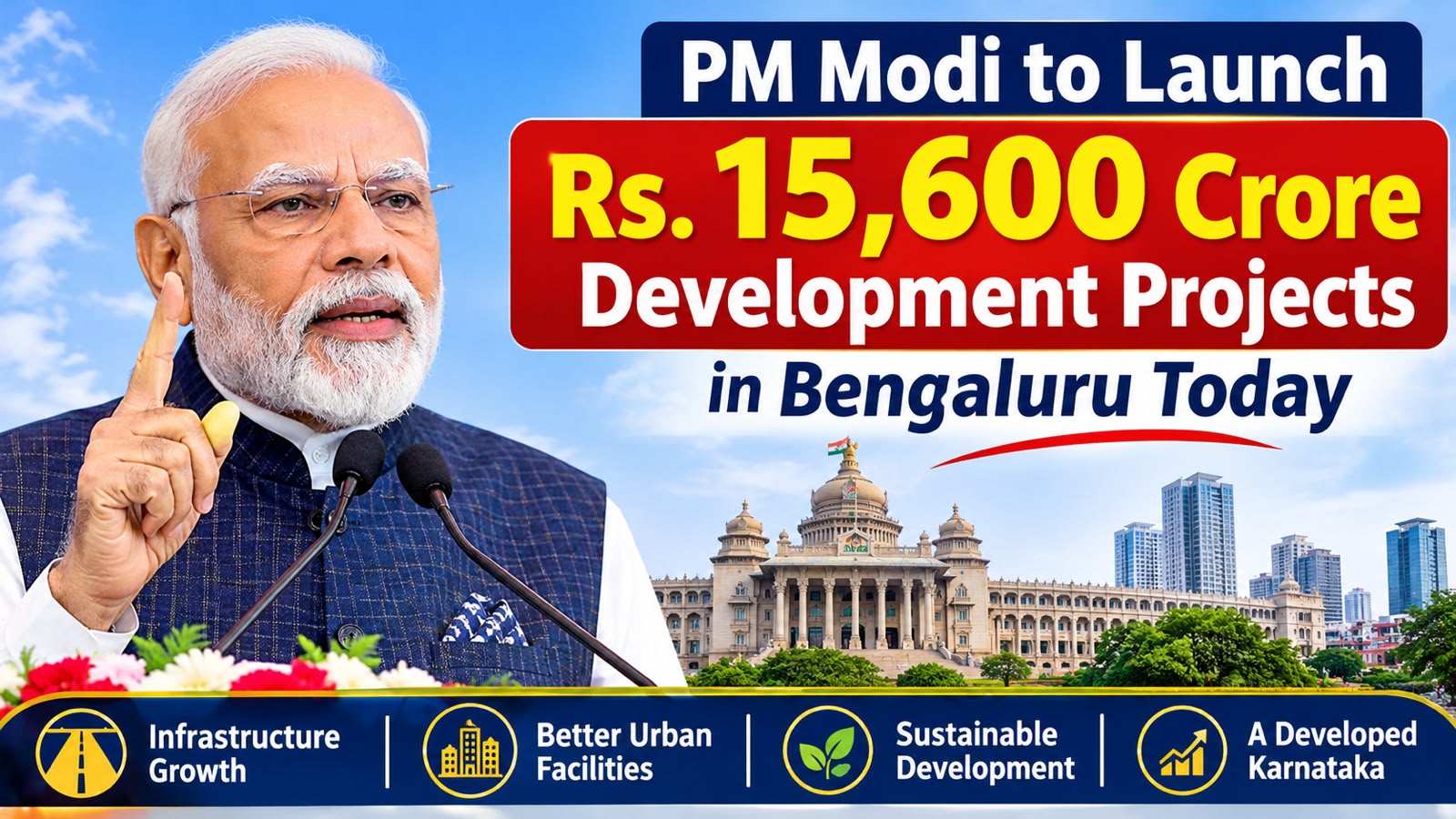
PM Modi to Launch Development Projects Worth Over Rs.15,600 Crore in Bengaluru Today: Metro, Railways, Renewable Energy and More
Bengaluru, November 13, 2026: Prime Minister Narendra Modi is set to launch and dedicate development projects worth more than Rs.15,600 crore in Bengaluru, Karnataka, today. The projects cover several important sectors, including urban transportation, renewable energy, railway infrastructure, petroleum storage, waste management and scientific education.
The development programme is expected to strengthen Karnataka's infrastructure, improve connectivity, support energy security and create new opportunities for economic growth. Among the major highlights are the inauguration of the Bengaluru Metro Pink Line, renewable energy transmission projects, an underground LPG storage facility in Mangaluru and the flag-off of the Bengaluru-Mangaluru-Madgaon Vande Bharat Express.
The visit is part of the government's broader infrastructure development initiatives, with a focus on modernising transportation networks and strengthening India's energy ecosystem.
PM Modi's Bengaluru Visit: Major Projects at a Glance
The key projects included in the development programme are:
- Inauguration of the Bengaluru Metro Pink Line.
- Renewable energy transmission projects across Karnataka.
- Dedication of India's largest underground LPG storage cavern in Mangaluru.
- Inauguration of the Devangonthi Marketing Terminal.
- Foundation stone for a compressed biogas plant in Bengaluru.
- Redevelopment of four railway stations under the Amrit Bharat Station Scheme.
- Dedication of the Bagalkot-Wandal railway line doubling section.
- Electrification of the Sakleshpur-Subrahmanya Road railway section.
- Flag-off of the Bengaluru-Mangaluru-Madgaon Vande Bharat Express.
- Inauguration of the COSMOS-Mysuru Planetarium.
Bengaluru Metro Pink Line to Improve City Connectivity
One of the biggest highlights of Prime Minister Modi's visit is the inauguration of the Bengaluru Metro Pink Line stretch between Kalena Agrahara and Tavarekere.
Developed at an estimated cost of approximately Rs.3,470 crore, the new metro stretch is expected to improve connectivity across southern Bengaluru and provide additional transportation options to daily commuters.
Bengaluru has experienced increasing traffic congestion due to rapid urbanisation, population growth and expanding commercial activities. Metro expansion is an important part of addressing the city's transportation requirements.
The Pink Line is expected to benefit office employees, students, business professionals and residents travelling across the city. It will also encourage greater use of public transportation and potentially reduce dependence on private vehicles.
As part of the programme, the Prime Minister is scheduled to flag off the metro service and undertake a journey from Tavarekere to IIM Bangalore Metro Station.
Renewable Energy Transmission Projects to Strengthen Karnataka's Power Infrastructure
Renewable energy infrastructure is another major focus of the development programme.
Karnataka is among India's important renewable energy-producing states, with substantial solar and wind energy potential. However, efficient transmission infrastructure is necessary to transport electricity from generation locations to major consumption centres.
The projects include the Koppal-II and Gadag-II renewable energy transmission scheme, the Bidar Solar Energy Zone transmission project and additional transmission infrastructure in the Davanagere-Chitradurga and Ballari regions.
The Koppal-II and Gadag-II transmission scheme, estimated at approximately Rs.4,450 crore, will facilitate the evacuation of around 2 GW of renewable energy.
The Bidar Solar Energy Zone transmission project, involving an investment of approximately Rs.1,370 crore, will support the evacuation of around 2.5 GW of solar power.
Other transmission projects are expected to strengthen the electricity network and improve the integration of renewable energy into the national grid.
These investments are important for India's long-term clean energy ambitions. Stronger transmission networks can help reduce renewable energy evacuation bottlenecks and improve the reliability of electricity supply.
India's Largest Underground LPG Storage Facility in Mangaluru
Another significant project is the dedication of India's largest underground LPG storage cavern in Mangaluru.
Developed with an investment of more than Rs.850 crore, the facility has a storage capacity of approximately 80,000 metric tonnes.
The project also includes a 9.4-kilometre LPG pipeline connecting New Mangalore Port with the storage terminal.
LPG is an important household and commercial fuel in India. Therefore, strengthening storage and distribution infrastructure is essential for maintaining supply reliability and improving energy security.
The underground storage facility is expected to improve the country's LPG storage capabilities, strengthen supply-chain management and support the transportation of petroleum products.
Devangonthi Marketing Terminal to Strengthen Petroleum Distribution
The Prime Minister will also dedicate the Devangonthi Marketing Terminal of Mangalore Refinery and Petrochemicals Limited (MRPL).
The facility has been developed with an investment of approximately ?330 crore. It is expected to strengthen petroleum product storage and distribution infrastructure in Karnataka.
Improved terminal facilities can support more efficient transportation and distribution of fuel products while strengthening the regional petroleum supply network.
GAIL's Compressed Biogas Plant to Promote Waste-to-Energy
Waste management and alternative fuel production are also part of the development programme.
Prime Minister Modi will lay the foundation stone for GAIL's proposed Compressed Biogas (CBG) plant at Haralakunte in Bengaluru.
The plant is designed to process approximately 300 tonnes of municipal solid waste every day and produce around 12.6 tonnes of compressed biogas.
The project aims to convert suitable municipal waste into a valuable energy resource.
Compressed biogas can be used as an alternative to conventional fuels in different applications, including transportation and industrial activities.
The facility is expected to support scientific waste management, promote cleaner energy production and contribute to India's circular economy objectives.
Railway Infrastructure Development Across Karnataka
Railway development is another important component of the programme.
Prime Minister Modi will inaugurate four redeveloped railway stations under the Amrit Bharat Station Scheme:
- Chamarajanagar Railway Station
- Chikkamagaluru Railway Station
- Sakleshpur Railway Station
- Subrahmanya Road Railway Station
The redevelopment initiative aims to improve passenger facilities and provide better station infrastructure.
The Prime Minister will also dedicate the 45-kilometre Bagalkot-Wandal railway line doubling section, which forms part of the 284-kilometre Gadag-Hotgi Doubling Project.
Railway line doubling is important for increasing track capacity, improving train operations and supporting freight transportation.
Additionally, the electrification of the 55-kilometre Sakleshpur-Subrahmanya Road Ghat railway section will be dedicated. With this development, the entire Bengaluru-Mangaluru railway route will become fully electrified.
Railway electrification can improve operational efficiency and reduce dependence on diesel-powered locomotives.
Bengaluru-Mangaluru-Madgaon Vande Bharat Express to Boost Connectivity
The launch of the Bengaluru-Mangaluru-Madgaon Vande Bharat Express is another major highlight of the visit.
The new train service is expected to improve connectivity between Bengaluru, coastal Karnataka and Goa.
The route will serve important destinations, including Hassan, Sakleshpur, Mangaluru, Udupi, Murdeshwar, Gokarna, Karwar and Madgaon.
The introduction of the Vande Bharat service is expected to benefit business travellers, tourists, students and regular passengers.
It could also support tourism across Karnataka's coastal regions by providing a more comfortable and convenient railway travel option.
COSMOS-Mysuru Planetarium to Be Inaugurated
Following the Bengaluru programme, Prime Minister Modi will travel to Mysuru to inaugurate the COSMOS-Mysuru Planetarium.
The facility is being described as India's first LED dome planetarium. It features a 15-metre tilted dome equipped with approximately 4.2 crore individual LEDs.
The planetarium is expected to become an important destination for astronomy education, scientific learning and public engagement with space science.
Students, researchers and astronomy enthusiasts are expected to benefit from the advanced educational and visual facilities.
Prashanti Kutiram Celebrates Its Golden Jubilee
The Prime Minister will also participate in the Golden Jubilee celebrations of Prashanti Kutiram, the residential headquarters of Swami Vivekananda Yoga Anusandhana Samsthana (S-VYASA).
The institution, established in 1975, focuses on yoga education, research and the integration of traditional Indian knowledge with modern scientific approaches.
During the celebrations, the Prime Minister is scheduled to lay the foundation stone for the Golden Jubilee Administrative Block and launch the S-VYASA off-campus centre in Thiruvananthapuram, Kerala.
The Golden Jubilee celebrations will take place from November 13 to November 23, 2026, under the theme 'Towards Viksit Bharat 2047'.
PM Modi Karnataka Visit: Programme Schedule
The major events scheduled during the Prime Minister's Karnataka visit include:
|
Time |
Programme |
|
10:45 AM |
Golden Jubilee celebrations at Prashanti Kutiram |
|
12:45 PM |
Bengaluru Metro Pink Line flag-off and metro journey |
|
1:15 PM |
Launch of development projects worth over Rs.15,600 crore |
|
3:30 PM |
Tree plantation programme at Bharat Vann, Mysuru |
|
4:00 PM |
Inauguration of COSMOS-Mysuru Planetarium |
Timings are based on the announced programme and may be subject to change.
How Will the Rs.15,600 Crore Projects Benefit Karnataka?
The development programme covers infrastructure sectors that directly influence the state's economic and social development.
Improved urban mobility: The Bengaluru Metro expansion will provide additional public transportation capacity and improve connectivity for commuters.
Renewable energy growth: New transmission infrastructure will help Karnataka integrate more renewable electricity into the power grid.
Energy security: The underground LPG storage cavern and petroleum marketing terminal will strengthen fuel storage and distribution capabilities.
Employment opportunities: Infrastructure construction, operations, maintenance and supporting services can generate employment and business opportunities.
Tourism development: Railway station redevelopment and the new Vande Bharat service could improve tourism connectivity across Karnataka and neighbouring Goa.
Environmental sustainability: The compressed biogas project will connect municipal waste management with alternative fuel production.
The overall impact of these initiatives will depend on their timely implementation, operational efficiency and long-term utilisation.
Conclusion
Prime Minister Narendra Modi's visit to Karnataka on November 13, 2026, brings together development initiatives worth more than Rs.15,600 crore across transportation, renewable energy, petroleum infrastructure, waste management and scientific education.
The Bengaluru Metro Pink Line, renewable energy transmission projects, underground LPG storage facility and Bengaluru-Mangaluru-Madgaon Vande Bharat Express are among the key highlights.
These projects are expected to strengthen Karnataka's infrastructure network and support its growing urban, industrial and economic requirements.
Beyond Bengaluru, the initiatives also cover important locations such as Mangaluru, Mysuru, Bidar, Koppal, Gadag and other regions of the state.
Their long-term significance will be measured by the improvements they deliver in connectivity, energy security, public services and economic opportunities for people across Karnataka.
What's Hot
-

India WTC Final 2027 Qualification Chances: What Team India Needs
-

India Score 720/9 vs New Zealand: Highest Away Test Total, Historic Record
-

Georgia Beats South Carolina 34-6 to Clinch 2026 SEC Championship Berth
-

PM E-DRIVE Scheme Crosses 30 Lakh EV Sales Milestone
-
PM Modi's FICCI Speech 2026: Listen to Gandhi, Promote Swadeshi and Make India Self-Reliant
-

Trump, Xi and Putin Summit 2026: Key Agenda, Nuclear Weapons, Iran War and Ukraine
-
EV Sales Surge 69% in India During 2026 Festive Season
-

What Is ASEAN? 11 Member Countries and Why It Matters to India
-

India vs New Zealand 4th ODI: India Bowled Out for 89, Lose by 244 Runs
-
PM Modi to Launch Rs.15,600 Crore Development Projects in Bengaluru Today