

EV Sales Surge 69% in India During 2026 Festive Season
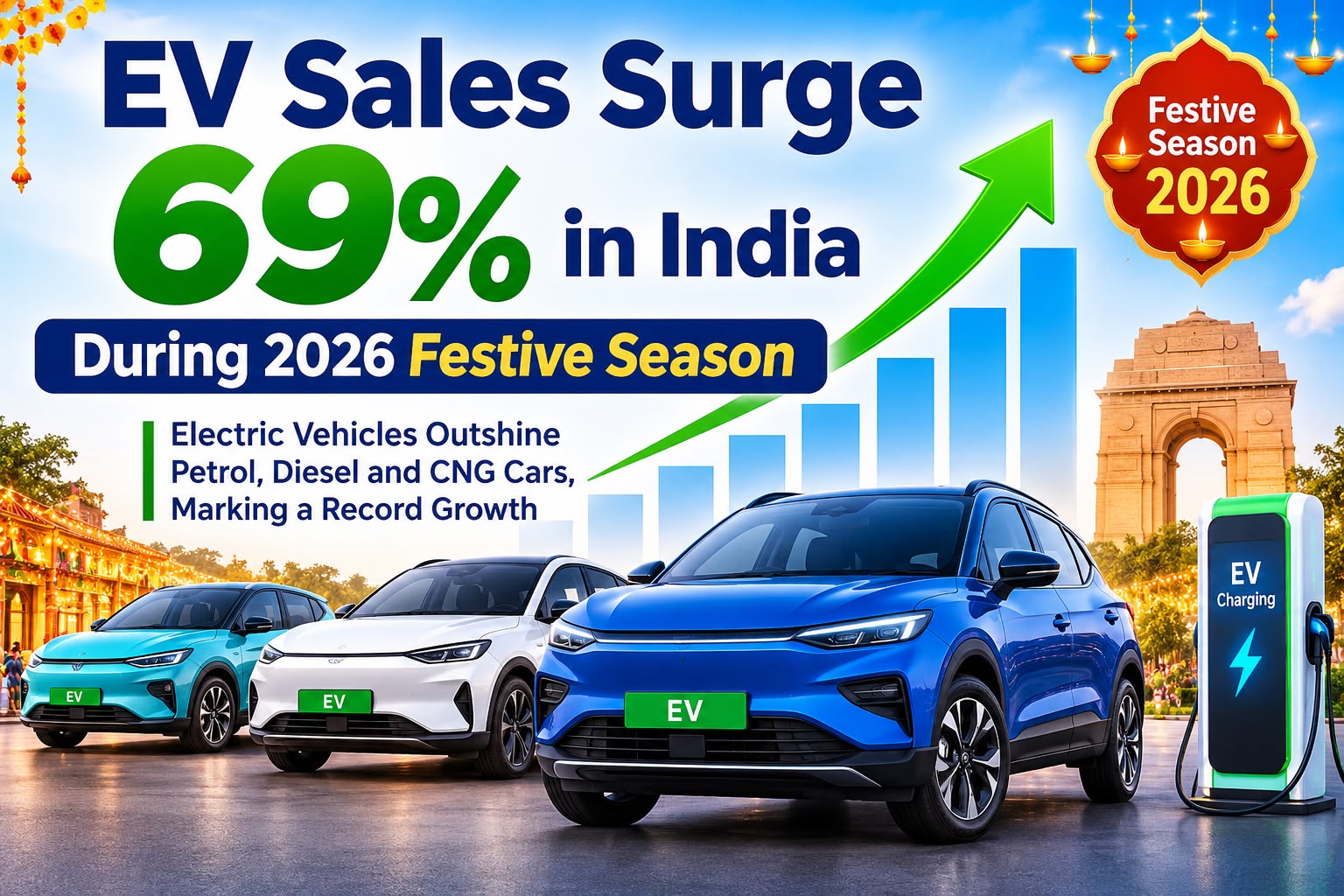
EV Sales Surge 69% During India's 2026 Festive Season as Petrol, Diesel and CNG Car Sales Decline
India's electric vehicle (EV) market has recorded remarkable growth during the 2026 festive season, with electric passenger car sales increasing by 69% year-on-year to 40,122 units. The impressive growth comes at a time when conventional petrol, diesel and CNG-powered car sales have declined, indicating a gradual shift in consumer preferences towards electric mobility.
According to retail sales data reported by The Economic Times, India's 32-day festive period, covering Navratri to Bhaidooj and ending November 11, 2026, witnessed strong demand for electric cars. The EV segment also increased its share of total passenger vehicle retail sales from 3.8% in the previous year to 6.9% in 2026.
The contrasting performance highlights the changing dynamics of India's automobile industry, where electric mobility is gaining momentum despite a slowdown in the overall passenger vehicle market.
EV Sales Increase to 40,122 Units During Festive Season
Electric passenger vehicle deliveries increased from approximately 23,740 units during the corresponding festive period last year to 40,122 units in 2026.
This represents a year-on-year growth of 69%, making electric vehicles the fastest-growing powertrain category during the festive season.
The festive period is particularly important for India's automobile industry, as customers traditionally prefer purchasing new vehicles during Navratri, Dussehra and Diwali.
The latest figures suggest that electric cars are becoming an increasingly attractive option for Indian buyers. Lower running costs, expanding model choices, improvements in battery technology and the gradual development of charging infrastructure are supporting this growth.
Petrol, Diesel and CNG Car Sales Witness Decline
While electric vehicles registered impressive growth, conventional fuel-powered passenger vehicles recorded a decline during the 2026 festive season.
The powertrain-wise performance highlights the contrasting trends in India's automobile market.
|
Vehicle category |
Year-on-year growth |
|
Electric cars |
+69% |
|
Petrol cars |
-14.5% |
|
Diesel cars |
-6.8% |
|
CNG cars |
-2.4% |
|
Overall passenger vehicles |
-7.2% |
Petrol cars witnessed the sharpest decline among conventional fuel categories, with deliveries falling from approximately 3.52 lakh units to 3.01 lakh units.
Diesel and CNG vehicles also recorded negative growth. Meanwhile, electric cars continued to attract customers and increased their contribution to total passenger vehicle sales.
One factor behind the decline in conventional vehicle sales was the strong festive performance in 2025, when GST rate reductions encouraged customers to purchase vehicles.
Electric Vehicle Market Share Rises to 6.9%
One of the most important developments during the 2026 festive season was the increase in the market share of electric passenger vehicles.
Electric cars accounted for 6.9% of total passenger vehicle retail deliveries, compared with 3.8% during the corresponding festive period last year.
This increase of 3.1 percentage points demonstrates the growing acceptance of electric mobility among Indian consumers.
Although EVs still represent a relatively small share of the overall passenger vehicle market, the latest growth indicates that electric cars are gradually moving towards mainstream adoption.
Tata Motors and Mahindra Lead India's Electric Car Market
Domestic automobile manufacturers continue to dominate India's electric passenger vehicle segment. Tata Motors and Mahindra & Mahindra recorded strong performances during the 2026 festive season.
Tata Motors Records 71% Growth
Tata Motors retained its leadership position in India's electric passenger vehicle market, recording 16,220 electric car deliveries during the festive period.
The company registered 71% year-on-year growth, supported by demand for its expanding electric vehicle portfolio.
Models such as the Nexon.ev, Punch.ev, Tiago.ev and Curvv.ev have helped Tata Motors establish a strong presence across different price segments.
The company's expanding EV portfolio and established market presence continue to support its position in India's electric mobility sector.
Mahindra Records 84% Growth
Mahindra & Mahindra recorded 9,407 electric car deliveries during the festive season, registering an impressive 84% year-on-year increase.
The company's electric SUV portfolio, including the BE 6 and XEV 9e, has strengthened its position in India's premium electric vehicle segment.
Mahindra's faster growth compared with Tata Motors indicates increasing customer interest in electric SUVs.
Together, Tata Motors and Mahindra delivered 25,627 electric cars, accounting for approximately 64% of the total festive-season EV deliveries.
Rising EV Demand Creates Supply Challenges
The growing demand for electric cars is also creating production and supply challenges for automobile manufacturers.
According to reports, Tata Motors was meeting approximately 60-65% of customer demand for its electric vehicles. The company was planning to increase monthly supplies to nearly 20,000 units from around 16,000 units.
Mahindra has also indicated capacity constraints in meeting demand for its electric SUVs. The company planned to increase its monthly EV production capacity from approximately 8,000 units by another 4,000 units by February-March 2027.
These developments indicate that the next phase of EV growth will depend not only on customer demand but also on manufacturers' ability to expand production capacity and strengthen supply chains.
Why Are Indian Consumers Choosing Electric Cars?
Several factors are contributing to the increasing popularity of electric vehicles in India.
1. Lower Running Costs
Electric cars generally have lower energy costs per kilometre compared with petrol and diesel vehicles, particularly when owners charge their vehicles at home.
2. Increasing Model Choices
Automakers are introducing electric vehicles across multiple segments, including hatchbacks, compact SUVs, premium SUVs and luxury cars. This gives customers more choices when purchasing an EV.
3. Expanding Charging Infrastructure
The gradual expansion of public charging stations, residential charging facilities and highway charging networks is improving convenience for electric vehicle owners.
4. Environmental Awareness
Electric vehicles produce no tailpipe emissions, making them an attractive option for customers concerned about urban air pollution and environmental sustainability.
5. Government Initiatives
Central and state government initiatives supporting electric mobility, charging infrastructure and domestic battery manufacturing are contributing to the development of India's EV ecosystem.
Challenges Facing India's Electric Vehicle Industry
Despite strong growth, India's EV industry continues to face several challenges that could influence future adoption.
- Charging infrastructure: Charging stations remain unevenly distributed, particularly in smaller cities and rural areas.
- High purchase prices: Many electric cars have higher initial purchase prices than comparable petrol and CNG models.
- Range anxiety: Some buyers remain concerned about battery range and charging availability during long-distance journeys.
- Battery replacement costs: Long-term battery performance and replacement expenses remain important considerations.
- Resale value: The second-hand EV market is still developing, creating uncertainty about resale prices.
Addressing these challenges will be essential for making electric cars more accessible to a wider section of Indian consumers.
Growing EV Sales to Boost Charging Infrastructure Demand
The rapid increase in electric vehicle adoption is creating new business opportunities beyond automobile manufacturing.
As more electric cars enter the market, demand for charging stations, installation services, commissioning, operations and maintenance is also expected to increase.
Public charging stations, residential charging facilities, highway charging networks and commercial charging hubs will become increasingly important for supporting India's electric mobility ecosystem.
The integration of renewable energy, particularly solar power, with EV charging infrastructure could also play an important role in reducing dependence on conventional electricity sources.
For companies operating in the EV charging infrastructure sector, rising electric vehicle adoption presents opportunities to expand their installation, commissioning and maintenance networks across Indian cities.
India's Electric Vehicle Market Outlook for 2027
The 69% growth recorded during the 2026 festive season provides a positive indication of the future of India's electric passenger vehicle market.
The coming year could be important as established automobile manufacturers introduce new electric models, improve battery technology and expand production capacities.
Tata Motors and Mahindra are expected to remain important competitors, while other domestic and international manufacturers are also strengthening their electric vehicle strategies.
The next phase of growth will depend on affordable electric cars, improved driving ranges, faster charging technology, better after-sales services and wider charging infrastructure availability.
If these developments continue, electric vehicles could capture a larger share of India's passenger vehicle market over the next few years.
Conclusion
India's electric passenger vehicle market has delivered an impressive performance during the 2026 festive season, recording 40,122 deliveries and 69% year-on-year growth.
In comparison, petrol, diesel and CNG car deliveries declined by 14.5%, 6.8% and 2.4%, respectively. The EV share of total passenger vehicle retail sales also increased from 3.8% to 6.9%.
Tata Motors and Mahindra continued to strengthen their positions, together accounting for approximately 64% of festive-season electric car deliveries.
Although electric cars have not yet overtaken conventional fuel-powered vehicles in total sales volume, their rapid growth indicates a meaningful shift in India's automobile market.
The coming years will be crucial in determining how quickly electric mobility moves beyond early adoption and becomes a mainstream choice for Indian consumers.
What's Hot
-

India WTC Final 2027 Qualification Chances: What Team India Needs
-

India Score 720/9 vs New Zealand: Highest Away Test Total, Historic Record
-

Georgia Beats South Carolina 34-6 to Clinch 2026 SEC Championship Berth
-
PM E-DRIVE Scheme Crosses 30 Lakh EV Sales Milestone
-

PM Modi's FICCI Speech 2026: Listen to Gandhi, Promote Swadeshi and Make India Self-Reliant
-

Trump, Xi and Putin Summit 2026: Key Agenda, Nuclear Weapons, Iran War and Ukraine
-
EV Sales Surge 69% in India During 2026 Festive Season
-

What Is ASEAN? 11 Member Countries and Why It Matters to India
-

India vs New Zealand 4th ODI: India Bowled Out for 89, Lose by 244 Runs
-
PM Modi to Launch Rs.15,600 Crore Development Projects in Bengaluru Today