

What Is ASEAN? 11 Member Countries and Why It Matters to India
What Is ASEAN and Why Does It Matter to India? PM Modi's Philippines Visit Brings Focus on Strategic Partnership
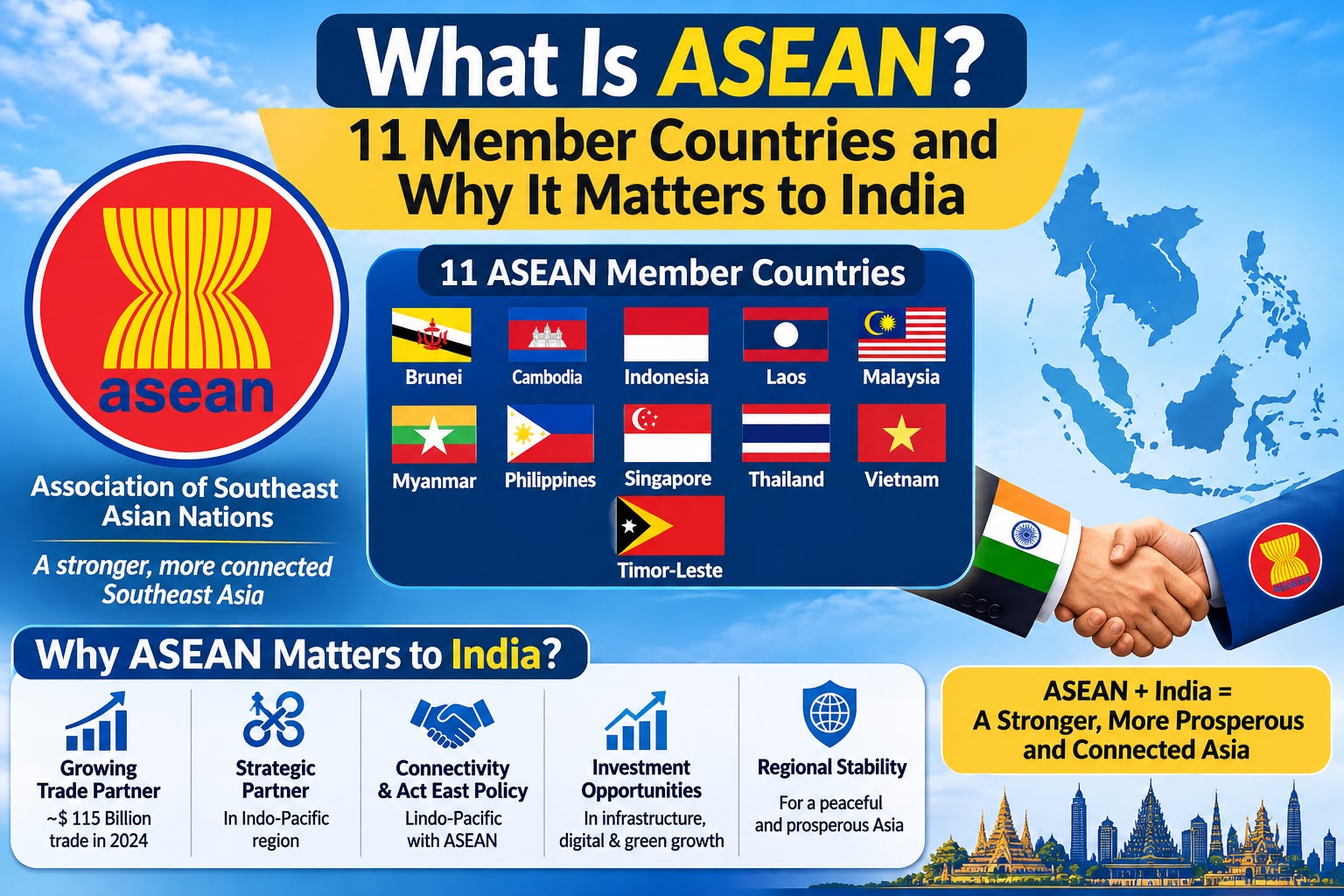
ASEAN, or the Association of Southeast Asian Nations, is an important regional organisation connecting 11 Southeast Asian countries. With a combined economy of more than US$4 trillion, the bloc plays a major role in global trade, manufacturing, investment and geopolitics. For India, ASEAN is a key economic and strategic partner, particularly under its Act East Policy. Prime Minister Narendra Modi's scheduled visit to the Philippines on November 16–17, 2026, for the ASEAN-India Summit and East Asia Summit has once again brought the importance of this regional partnership into focus.
What Is ASEAN?
ASEAN stands for the Association of Southeast Asian Nations. It was established on August 8, 1967, in Bangkok, Thailand, with the objective of promoting economic growth, regional peace, political stability and cooperation among Southeast Asian countries.
The organisation was initially established by five founding members: Indonesia, Malaysia, the Philippines, Singapore and Thailand.
Over the years, ASEAN expanded its membership and became an important regional platform for economic cooperation, international trade, diplomacy and security discussions.
Timor-Leste became ASEAN's 11th member in 2025, further expanding the organisation's geographical and economic presence.
The ASEAN Secretariat is headquartered in Jakarta, Indonesia.
List of 11 ASEAN Member Countries
ASEAN currently consists of the following 11 countries:
|
No. |
Country |
Capital |
|
1 |
Brunei Darussalam |
Bandar Seri Begawan |
|
2 |
Cambodia |
Phnom Penh |
|
3 |
Indonesia |
Jakarta |
|
4 |
Laos |
Vientiane |
|
5 |
Malaysia |
Kuala Lumpur |
|
6 |
Myanmar |
Naypyidaw |
|
7 |
Philippines |
Manila |
|
8 |
Singapore |
Singapore |
|
9 |
Thailand |
Bangkok |
|
10 |
Vietnam |
Hanoi |
|
11 |
Timor-Leste |
Dili |
These countries collectively represent a strategically important region connecting the Indian Ocean and Pacific Ocean.
How Powerful Is ASEAN Economically?
ASEAN has emerged as one of the world's significant economic regions, supported by its large population, expanding middle class, manufacturing industries and growing consumer demand.
According to ASEAN's 2025 statistical figures:
- Population: Approximately 693.2 million.
- Combined GDP: Approximately US$4.26 trillion.
- Merchandise trade: Approximately US$4.37 trillion.
- Foreign direct investment inflows: Approximately US$245.66 billion.
The region has developed strong industrial capabilities in electronics, automobiles, semiconductors, textiles, chemicals, pharmaceuticals and consumer goods.
Countries such as Singapore, Vietnam, Thailand, Malaysia and Indonesia have become important destinations for international investment and manufacturing.
This economic strength makes ASEAN an important partner for countries seeking to expand international trade and diversify global supply chains.
Why Does ASEAN Matter to India?
India and ASEAN share historical, cultural, geographical and economic connections. Over the past three decades, their relationship has developed into a comprehensive strategic partnership.
There are several reasons why ASEAN is important for India's economic development and international ambitions.
1. ASEAN Is a Major Trading Partner for India
Trade is one of the strongest pillars of India-ASEAN relations.
ASEAN provides Indian businesses with access to a large consumer market and international manufacturing networks.
India exports petroleum products, pharmaceuticals, chemicals, engineering goods, agricultural products, textiles and industrial equipment to Southeast Asian countries.
In return, India imports electronics, machinery, palm oil, coal, rubber, chemicals and other industrial inputs.
India-ASEAN bilateral merchandise trade was approximately US$123 billion in FY 2024–25, making the regional bloc one of India's important trading partners.
Stronger trade relations can create opportunities for Indian manufacturers, exporters, technology companies and investors.
2. ASEAN Is Central to India's Act East Policy
India's Act East Policy is a major component of its foreign policy and international economic engagement.
Announced in 2014, the policy evolved from India's earlier Look East Policy, which was launched in the early 1990s.
Its objective is to strengthen India's economic, diplomatic, cultural and strategic relationships with Southeast Asian and East Asian countries.
ASEAN is at the centre of this policy.
Through greater cooperation with ASEAN, India aims to expand trade, improve infrastructure connectivity, strengthen defence relations, attract investments and develop stronger regional supply chains.
The policy also supports India's broader engagement with the Indo-Pacific region.
3. Strategic Importance in the Indo-Pacific Region
The Indo-Pacific region has become increasingly important for global trade, maritime transportation and international security.
Several ASEAN countries are located near strategically important shipping routes connecting the Indian Ocean and Pacific Ocean.
The Strait of Malacca, located between the Malay Peninsula and the Indonesian island of Sumatra, is one of the world's major maritime trade routes.
A significant volume of international commercial goods and energy shipments passes through this region.
For India, secure maritime routes are essential for international trade, energy imports, shipping operations and economic stability.
India therefore works with ASEAN countries through defence dialogues, naval exercises and maritime cooperation initiatives.
4. Better Connectivity Between India and Southeast Asia
Infrastructure connectivity is another important pillar of India-ASEAN cooperation.
India shares a land border with Myanmar, providing a geographical connection between Northeast India and Southeast Asia.
Two major infrastructure initiatives are particularly important.
India-Myanmar-Thailand Trilateral Highway: The proposed highway aims to connect Moreh in Manipur with Mae Sot in Thailand through Myanmar. It is expected to improve road connectivity, facilitate cross-border trade and create opportunities for tourism and business.
Kaladan Multi-Modal Transit Transport Project: This project aims to connect India's eastern seaport infrastructure with Mizoram through Myanmar using sea, inland waterways and road transportation.
Both projects are expected to improve logistics and provide Indian businesses with better access to Southeast Asian markets. However, their progress depends on construction and security conditions, particularly in Myanmar.
5. Energy Security and Renewable Energy Cooperation
ASEAN is important for India's long-term energy security.
Countries such as Indonesia, Malaysia and Brunei are significant sources of energy and natural resources.
India's engagement with Southeast Asia can help diversify energy supply chains and strengthen cooperation in petroleum, natural gas, LNG and other resources.
There are also opportunities in emerging energy sectors, including solar power, wind energy, green hydrogen, battery manufacturing, energy storage and electric vehicle infrastructure.
As India continues to expand its renewable energy capacity, cooperation with ASEAN could create opportunities for Indian energy companies, engineering businesses and infrastructure developers.
6. Investment and Manufacturing Opportunities
ASEAN has become an important manufacturing and investment destination.
Countries such as Vietnam, Thailand, Malaysia, Indonesia and Singapore have established strong industrial and business ecosystems.
Indian companies can explore opportunities in:
- Electronics and semiconductor manufacturing.
- Electric vehicles and automobile components.
- Pharmaceuticals and healthcare.
- Renewable energy and energy storage.
- Information technology and software services.
- Infrastructure and logistics.
- Food processing and agricultural technology.
- Banking and financial technology.
Greater economic cooperation could help Indian companies enter new markets, develop international partnerships and diversify supply chains.
7. Historical and Cultural Connections
India and Southeast Asia share centuries-old cultural, religious and historical connections.
Indian traditions, languages, literature, architecture and religious philosophies have influenced several Southeast Asian societies.
Angkor Wat in Cambodia, Borobudur in Indonesia and different cultural versions of the Ramayana across Southeast Asia reflect these historical connections.
Ancient maritime trade networks also connected Indian merchants with Southeast Asian communities.
These shared traditions continue to support tourism, educational exchanges, cultural cooperation and diplomatic relations.
PM Modi's Philippines Visit: ASEAN in Focus on November 16–17, 2026
Prime Minister Narendra Modi is scheduled to visit Manila, the capital of the Philippines, from November 16 to 17, 2026, at the invitation of Philippine President Ferdinand R. Marcos Jr.
The visit is particularly important because the Philippines is holding the ASEAN Chairmanship for 2026.
During his visit, PM Modi is scheduled to participate in two major regional diplomatic gatherings on November 17:
- The 23rd ASEAN-India Summit.
- The 21st East Asia Summit.
The visit provides an opportunity for India to strengthen its relationship with Southeast Asian nations and discuss important regional and international developments.
Key Details of PM Modi's Philippines Visit
- Indian Prime Minister: Narendra Modi
- Destination: Manila, Philippines
- Visit dates: November 16–17, 2026
- Host country: Philippines
- Philippine President: Ferdinand R. Marcos Jr.
- ASEAN Summit: 23rd ASEAN-India Summit
- Other major meeting: 21st East Asia Summit
- ASEAN Chair for 2026: Philippines
What Will Be Discussed at the ASEAN-India Summit?
The ASEAN-India Summit will provide a platform for leaders to review their existing partnership and discuss future areas of cooperation.
Important subjects include:
- Expanding bilateral trade and investment.
- Improving regional infrastructure and connectivity.
- Strengthening maritime security.
- Cooperation in digital technology and innovation.
- Renewable energy and sustainable development.
- Strengthening regional supply chains.
- Promoting peace and stability in the Indo-Pacific.
The 21st East Asia Summit will provide another opportunity for PM Modi to engage with regional leaders on international security, economic cooperation and geopolitical developments.
2026: ASEAN-India Year of Maritime Cooperation
Another important development is that India and ASEAN are observing 2026 as the ASEAN-India Year of Maritime Cooperation.
The initiative highlights the importance of safe maritime transportation, regional security, sustainable use of ocean resources and cooperation at sea.
This is particularly relevant for India because a large portion of its international trade and energy transportation depends on secure maritime routes.
India and ASEAN will also approach two important diplomatic milestones in 2027: 35 years of dialogue relations and five years of their Comprehensive Strategic Partnership.
India-ASEAN Relations: Important Milestones
India's engagement with ASEAN has expanded significantly over the past three decades.
|
Year |
Major development |
|
1992 |
India became an ASEAN Sectoral Dialogue Partner. |
|
1995 |
India became a Full Dialogue Partner. |
|
2002 |
First ASEAN-India Summit was held. |
|
2003 |
Framework Agreement on Comprehensive Economic Cooperation was signed. |
|
2010 |
ASEAN-India Trade in Goods Agreement came into force. |
|
2014 |
India announced its Act East Policy. |
|
2015 |
Agreements on trade in services and investment came into force. |
|
2018 |
ASEAN leaders attended India's Republic Day celebrations as chief guests. |
|
2022 |
India and ASEAN elevated their relationship to a Comprehensive Strategic Partnership. |
|
2026 |
ASEAN-India Year of Maritime Cooperation. |
This timeline demonstrates how India-ASEAN relations have developed from diplomatic engagement into a broader partnership covering trade, investment, defence, technology and regional development.
What Is the ASEAN-India Free Trade Agreement?
The ASEAN-India Trade in Goods Agreement (AITIGA) is an important component of economic cooperation between India and Southeast Asian countries.
The agreement was signed on August 13, 2009, and came into force on January 1, 2010.
It aims to reduce or eliminate tariffs on a substantial portion of goods traded between India and ASEAN countries.
India and ASEAN have also established agreements covering trade in services and investment, which came into force in 2015.
However, India has raised concerns regarding trade imbalances, market access and the implementation of rules of origin.
The ongoing review of AITIGA is intended to make the agreement more effective, business-friendly and supportive of balanced trade.
A more effective agreement could help Indian exporters compete in Southeast Asian markets while encouraging greater industrial cooperation and investment.
What Challenges Does ASEAN Face?
Despite its economic and strategic importance, ASEAN faces several challenges.
South China Sea disputes: Territorial and maritime disagreements involving China and several ASEAN members remain an important regional concern.
Myanmar's political crisis: Political instability and ongoing conflict in Myanmar have complicated ASEAN's efforts to maintain regional peace.
Economic inequalities: Member countries have different levels of economic development, industrial capabilities and infrastructure.
Differences in political systems: ASEAN members have different political priorities and international relationships, which can make collective decision-making difficult.
US-China competition: Strategic competition between the United States and China creates additional diplomatic and economic challenges for Southeast Asian countries.
ASEAN generally follows a consensus-based decision-making approach. This helps maintain cooperation among members but can also make it difficult to reach common positions on sensitive regional issues.
What Is the Future of India-ASEAN Relations?
The future of India-ASEAN relations is likely to be shaped by economic integration, technological development, infrastructure connectivity and regional security.
Some of the most promising areas include:
- Electric mobility: Cooperation in EV manufacturing, battery technology and charging infrastructure.
- Semiconductors: Building stronger electronics and semiconductor supply chains.
- Renewable energy: Joint investments in solar, wind and green hydrogen.
- Digital economy: Cooperation in artificial intelligence, fintech and cybersecurity.
- Infrastructure: Developing highways, ports, logistics and transportation networks.
- Defence: Strengthening maritime security and defence partnerships.
- Tourism: Improving connectivity and encouraging people-to-people exchanges.
For India, stronger cooperation with ASEAN could support its ambitions to become a major manufacturing, technology and export hub.
Conclusion: Why ASEAN Is Important for India's Global Ambitions
ASEAN is much more than a regional organisation representing Southeast Asian countries. It is an important economic, diplomatic and strategic partner for India.
With a population of approximately 693 million and a combined economy of around US$4.26 trillion, ASEAN represents a significant market for Indian businesses, manufacturers and exporters.
The partnership is important for India's Act East Policy, international trade, energy security, infrastructure development and strategic engagement in the Indo-Pacific.
Prime Minister Narendra Modi's scheduled visit to the Philippines on November 16–17, 2026, further highlights India's growing engagement with Southeast Asia.
His participation in the 23rd ASEAN-India Summit and the 21st East Asia Summit will provide an opportunity to review existing cooperation and discuss future priorities.
As global economic and geopolitical dynamics continue to evolve, India-ASEAN cooperation will remain an important factor in shaping Asia's economic and strategic future.
What's Hot
-
India WTC Final 2027 Qualification Chances: What Team India Needs
-
India Score 720/9 vs New Zealand: Highest Away Test Total, Historic Record
-

Georgia Beats South Carolina 34-6 to Clinch 2026 SEC Championship Berth
-

PM E-DRIVE Scheme Crosses 30 Lakh EV Sales Milestone
-
PM Modi's FICCI Speech 2026: Listen to Gandhi, Promote Swadeshi and Make India Self-Reliant
-
Trump, Xi and Putin Summit 2026: Key Agenda, Nuclear Weapons, Iran War and Ukraine
-
EV Sales Surge 69% in India During 2026 Festive Season
-
What Is ASEAN? 11 Member Countries and Why It Matters to India
-
India vs New Zealand 4th ODI: India Bowled Out for 89, Lose by 244 Runs
-
PM Modi to Launch Rs.15,600 Crore Development Projects in Bengaluru Today