

PM E-DRIVE Scheme Crosses 30 Lakh EV Sales Milestone
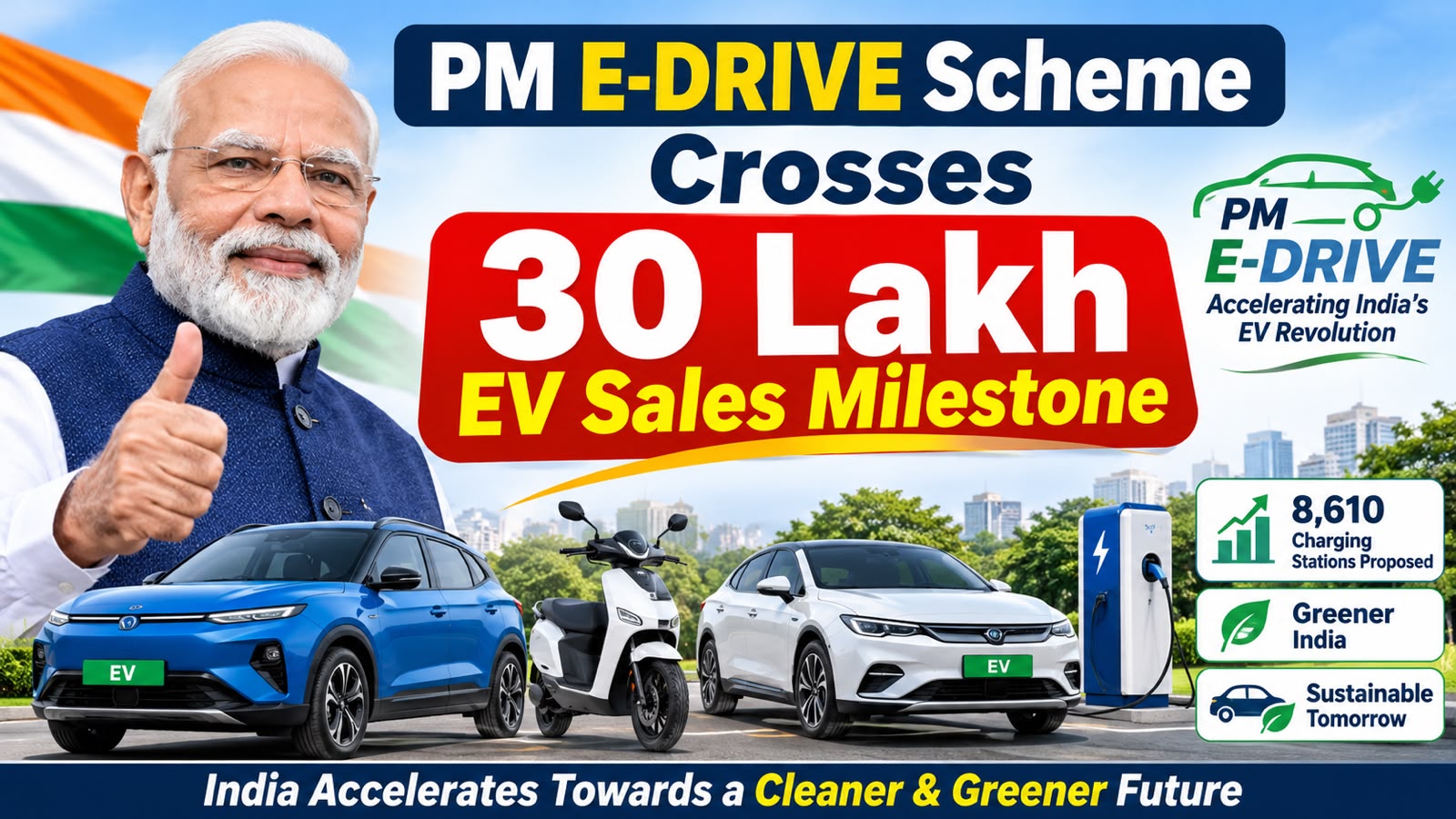
PM E-DRIVE Scheme Crosses 30 Lakh EV Sales Milestone
The PM Electric Drive Revolution in Innovative Vehicle Enhancement (PM E-DRIVE) Scheme has emerged as an important government initiative to accelerate electric mobility in India.
According to the latest announcement, over 30 lakh electric vehicles have been sold under the scheme by September 30, 2026. This represents substantial progress in the government's efforts to encourage consumers to switch from petrol and diesel-powered vehicles to electric alternatives.
The scheme was initially introduced with a financial outlay of Rs.10,900 crore. Following a revision in August 2026, its total allocation was increased to Rs.11,900 crore, with implementation extended until March 31, 2028.
The programme supports multiple electric vehicle categories, including electric two-wheelers, three-wheelers, electric ambulances and electric trucks. It also provides financial support for public charging infrastructure and the development of domestic EV manufacturing capabilities.
Government Sanctions Rs.904 Crore for 8,610 EV Charging Stations
One of the most important announcements is the allocation of Rs.904 crore for 8,610 proposed public electric vehicle charging stations across India.
The government has earmarked a total of Rs.2,000 crore under PM E-DRIVE for developing public EV charging infrastructure. The latest sanction represents an important step towards expanding the country's charging network.
Earlier, government data indicated that ?851 crore had been approved for 8,147 chargers as of September 28, 2026. The latest announcement increases the number to 8,610 charging stations.
However, it is important to understand that these figures represent sanctioned and proposed infrastructure projects, not necessarily charging stations that are already installed and operational.
The expansion is expected to improve charging accessibility for electric vehicle owners and encourage greater EV adoption, particularly in locations where charging infrastructure remains limited.
Government Focuses on Charging Infrastructure Beyond Metro Cities
Speaking at the SIAM National EV Charging Day event, Union Minister H. D. Kumaraswamy highlighted the importance of expanding charging infrastructure beyond India's major metropolitan cities.
The government wants charging facilities to reach smaller towns, rural areas, peri-urban regions, industrial clusters, tourism circuits and emerging economic corridors.
The minister also emphasised that developing charging infrastructure requires coordinated participation from several stakeholders, including:
- Electric vehicle manufacturers
- Charging point operators
- Oil marketing companies
- Energy and power distribution companies
- Technology providers
- Real estate developers
- Financial institutions
- Central and state governments
The government is also focusing on the requirements of electric buses and trucks, which need higher-capacity charging facilities compared with conventional electric two-wheelers and passenger vehicles.
PM E-DRIVE Scheme: Key Financial Allocations
The PM E-DRIVE Scheme has been designed to support the development of India's electric mobility ecosystem through financial incentives and infrastructure investments.
Some of its major allocations include:
|
Component |
Allocation / Target |
|
Total revised scheme outlay |
Rs.11,900 crore |
|
EV public charging infrastructure |
Rs.2,000 crore |
|
Charging stations proposed in latest announcement |
8,610 |
|
Funding sanctioned for proposed charging stations |
Rs.904 crore |
|
Electric buses allocation |
Rs.4,391 crore |
|
Electric buses targeted |
14,028 |
|
Vehicle testing infrastructure |
Rs.780 crore |
The government has also allocated Rs.4,391 crore for the deployment of 14,028 electric buses. By August 2026, 14,000 buses had been allocated, including 13,800 buses for seven major cities: Delhi, Bengaluru, Hyderabad, Mumbai, Ahmedabad, Pune and Surat.
These initiatives demonstrate that the government's electric mobility strategy extends beyond private vehicle ownership to include public transportation and supporting infrastructure.
How PM E-DRIVE Incentives Help EV Buyers
A major objective of the PM E-DRIVE Scheme is to make electric vehicles more affordable by reducing their initial purchase cost.
Eligible buyers can receive demand incentives on selected electric vehicle categories. These incentives are provided upfront to consumers and subsequently reimbursed to the original equipment manufacturers by the government.
For eligible electric two-wheelers, the scheme provides incentives of Rs.2,500 per kWh, subject to a maximum of Rs.5,000 per vehicle or 15% of its ex-factory price, whichever is lower, for applicable registrations from April 2025.
The electric two-wheeler incentive applies to eligible vehicles with an ex-factory price of up to Rs.1.5 lakh.
The scheme also supports eligible electric three-wheelers, including e-rickshaws and e-carts, as well as electric ambulances and electric trucks.
The purchase incentive process uses an electronic voucher system. Buyers complete Aadhaar-based face authentication, after which the scheme generates an e-voucher that can be submitted to the dealer to claim the applicable benefit.
It is important to note that not every electric vehicle automatically qualifies for PM E-DRIVE benefits. Eligibility depends on the vehicle category, price limits, technical approvals and other scheme conditions.
What Does This Mean for India's EV Industry?
Crossing the 30-lakh sales milestone under PM E-DRIVE reflects the growing acceptance of electric mobility in India.
However, the next phase of EV growth will depend not only on vehicle sales but also on the availability, reliability and accessibility of charging infrastructure.
Charging availability remains an important consideration for consumers planning to purchase electric cars, scooters and commercial vehicles. A wider charging network can help reduce range anxiety and make long-distance electric travel more convenient.
For businesses, the expansion also creates opportunities in EV charging station installation, electrical infrastructure, operations and maintenance, software solutions and energy management.
The participation of private companies and charging infrastructure operators will be essential to ensure that proposed charging stations become fully operational facilities.
Conclusion
The sale of more than 30 lakh electric vehicles under the PM E-DRIVE Scheme marks an important milestone in India's transition towards sustainable transportation.
With ?904 crore sanctioned for 8,610 proposed charging stations and the overall scheme outlay increased to Rs.11,900 crore, the government is strengthening its efforts to support EV adoption and charging infrastructure development.
As India moves towards a cleaner mobility ecosystem, the successful implementation of these charging projects will be crucial in making electric vehicles more accessible and practical for consumers, businesses and public transport operators across the country.
What's Hot
-

India WTC Final 2027 Qualification Chances: What Team India Needs
-

India Score 720/9 vs New Zealand: Highest Away Test Total, Historic Record
-

Georgia Beats South Carolina 34-6 to Clinch 2026 SEC Championship Berth
-
PM E-DRIVE Scheme Crosses 30 Lakh EV Sales Milestone
-
PM Modi's FICCI Speech 2026: Listen to Gandhi, Promote Swadeshi and Make India Self-Reliant
-

Trump, Xi and Putin Summit 2026: Key Agenda, Nuclear Weapons, Iran War and Ukraine
-
EV Sales Surge 69% in India During 2026 Festive Season
-

What Is ASEAN? 11 Member Countries and Why It Matters to India
-

India vs New Zealand 4th ODI: India Bowled Out for 89, Lose by 244 Runs
-
PM Modi to Launch Rs.15,600 Crore Development Projects in Bengaluru Today