

Royal Enfield Continental GT 750 Unveiled: 743cc Engine, Price & Launch
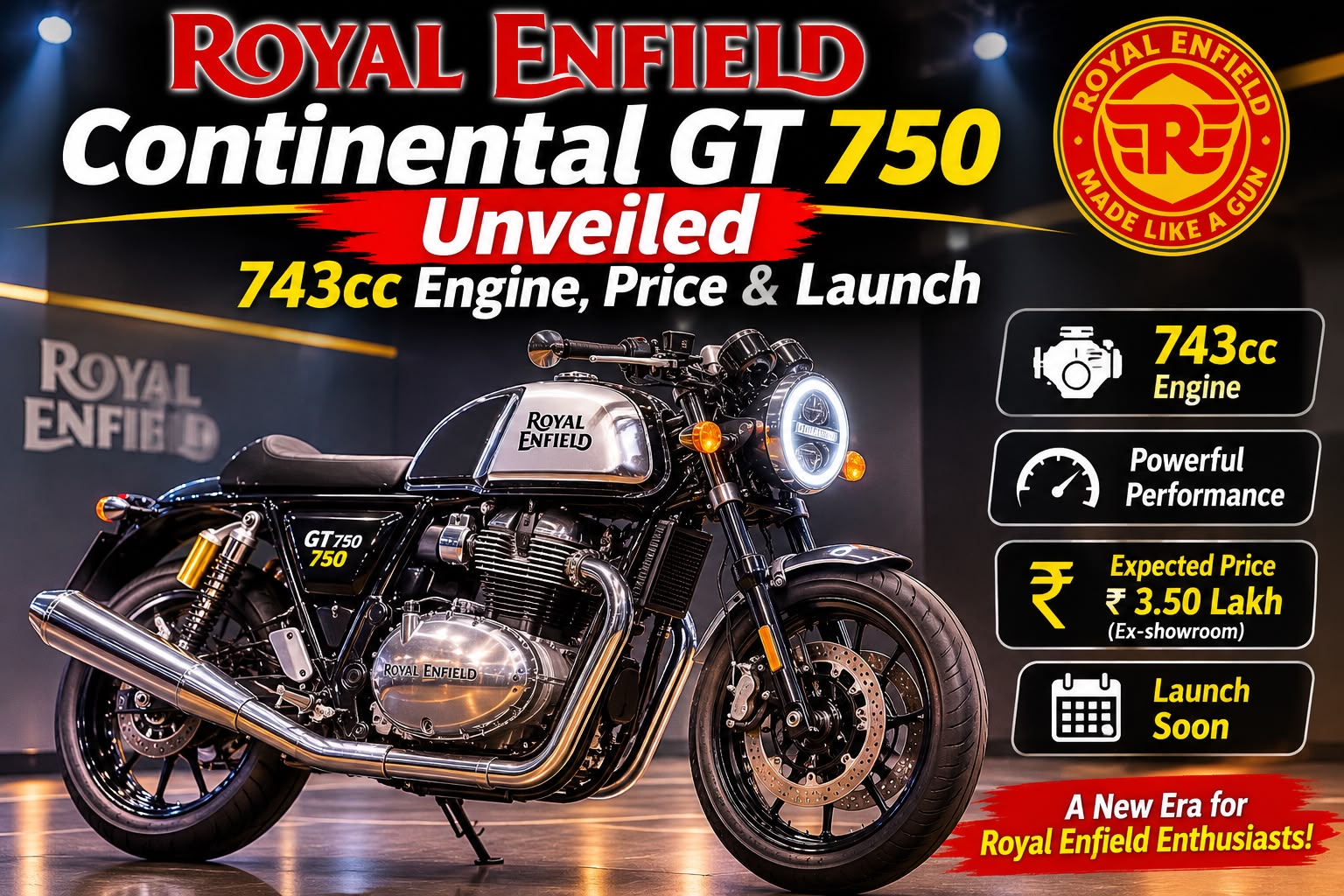
Royal Enfield Continental GT 750 Unveiled: A New 743cc Café Racer Arrives with Two Distinct Personalities
November 3, 2026 | Automobile News | Motorcycle Launches
Royal Enfield is preparing to make its café-racer legacy bigger, faster and more exciting. The company has unveiled the new Continental GT 750 at EICMA 2026, introducing a larger 743cc parallel-twin engine, updated mechanical components and two distinct styling personalities.
The new motorcycle is more than an engine-capacity upgrade to the popular Continental GT 650. It represents Royal Enfield's ambition to move further into the premium middleweight motorcycle category while retaining the retro-inspired character that has made the GT family popular among enthusiasts.
The biggest talking point is the decision to showcase two versions of the motorcycle – one with a sporty front fairing and another retaining the traditional naked café-racer appearance. Combined with three distinctive colour schemes, the new GT 750 gives customers more choice without moving away from its familiar design identity.
With a bigger engine, revised braking hardware and updated instrumentation, the Continental GT 750 could become an important motorcycle for Royal Enfield in the coming years.
A Familiar Café Racer with a Bigger Ambition
The Continental GT has always represented a different side of Royal Enfield. While many motorcycles from the brand focus on relaxed cruising and everyday riding, the GT family has traditionally appealed to customers who enjoy a sportier riding position and classic racing-inspired design.
The new GT 750 continues this philosophy but takes it into a larger performance category.
Its overall proportions retain the familiar sculpted fuel tank, compact rear section, twin exhausts and café-racer seating arrangement. However, the redesigned front section, new instrumentation and additional mechanical upgrades give it a more contemporary identity.
For Royal Enfield, the challenge is to improve performance without losing the character that existing GT owners appreciate.
Two Designs, Two Different Riding Personalities
One of the most interesting aspects of the new Continental GT 750 is its two-version approach.
1. The Faired GT 750: Inspired by Classic Racing Machines
The faired version is designed for enthusiasts who want their motorcycle to make a stronger visual statement.
Its front quarter fairing creates a racing-inspired appearance, complemented by lower clip-on handlebars and side number boards. The overall design takes inspiration from traditional café racers and classic competition motorcycles.
The lower handlebars also create a more forward-leaning riding position, making this version look and feel sportier.
This configuration is particularly interesting for riders who appreciate the visual appeal of old-school racing motorcycles.
2. The Unfaired GT 750: Keeping the Original Café Racer Spirit
The second version takes a more traditional approach.
Without the additional front fairing, it retains the clean silhouette associated with the Continental GT family. The sculpted tank, exposed engine and twin exhaust arrangement remain the main visual attractions.
Its relatively higher handlebar position also gives it a different riding character compared with the faired configurations.
For existing Continental GT enthusiasts, this version may feel like a natural evolution of the motorcycle they already know.
743cc Twin Engine: The Real Story Behind the Upgrade
The biggest change is mechanical rather than cosmetic.
The Continental GT 750 gets a new 743cc parallel-twin engine, based on the same basic platform as the Himalayan 750 but developed with a different specification for the GT.
The larger displacement should provide additional performance potential over the existing 648cc engine.
Key engine details:
|
Specification |
Details |
|
Engine capacity |
743cc |
|
Configuration |
Parallel-twin |
|
Cooling |
Air/oil-cooled |
|
Valve arrangement |
SOHC |
|
Throttle |
Cable-operated |
|
Exhaust |
Twin exhaust |
|
Engine character |
Sport-oriented tuning |
The GT 750 also differs from the Himalayan 750 in its exhaust arrangement and throttle setup.
For comparison, the Himalayan 750 produces 55 hp and 63 Nm of torque. However, these figures should not be directly applied to the Continental GT 750 because its engine specification is different.
Royal Enfield has yet to disclose the final power and torque figures for the new café racer.
The important question will be how the manufacturer balances acceleration, mid-range performance and highway cruising capability.
More Than Just Engine Capacity: Improved Braking and Hardware
A larger engine makes little difference if the rest of the motorcycle cannot support the additional performance.
Royal Enfield appears to have considered this with the updated mechanical package.
The GT 750 gets twin front disc brakes instead of the single front disc arrangement used on the GT 650. It also features dual-channel ABS and updated suspension components.
Other visible hardware includes:
- Telescopic front forks.
- Twin rear shock absorbers.
- Rear disc brake.
- 18-inch wheels.
- Updated switchgear.
- Revised suspension setup.
The faired and unfaired configurations also differ in their handlebar ergonomics, giving buyers different riding experiences.
These changes could make the new motorcycle more appealing to riders who want a premium café racer rather than simply a bigger-capacity version of the existing model.
Three Colours That Give the GT 750 Its Own Identity
Royal Enfield has showcased the motorcycle in three colour schemes: Red Line, TT Blue and Master Clean.
Each configuration has its own visual character.
Red Line: A racing-inspired red version with front fairing and wire-spoke wheels.
TT Blue: A blue version with a sporty fairing and alloy wheels, offering the convenience of tubeless tyres.
Master Clean: A more traditional unfaired configuration with a distinctive chrome appearance and wire-spoke wheels.
The different wheel configurations are worth noting because they offer customers a choice between traditional styling and everyday tyre convenience.
A Modern Dashboard Without Losing the Retro Character
Royal Enfield has avoided giving the GT 750 an overly futuristic appearance.
The motorcycle features a hybrid twin-pod TFT instrument cluster, retaining the traditional circular arrangement while incorporating digital technology.
This is a sensible design direction for a motorcycle whose appeal depends heavily on its retro identity.
The updated switchgear, including metal-finish switch cubes, further contributes to its premium appearance.
Rather than transforming the Continental GT into a completely modern sports motorcycle, Royal Enfield appears to have focused on upgrading the experience while preserving its original personality.
Continental GT 750 vs GT 650: What Has Changed?
The new motorcycle is expected to become an upgrade option for existing GT 650 owners.
|
Feature |
Continental GT 650 |
Continental GT 750 |
|
Engine |
648cc |
743cc |
|
Engine layout |
Parallel-twin |
Parallel-twin |
|
Cooling |
Air/oil |
Air/oil |
|
Front brakes |
Single disc |
Twin discs |
|
Instrumentation |
Analogue twin-pod |
Hybrid twin-pod TFT |
|
Exhaust |
Twin |
Twin |
|
Design |
Traditional café racer |
Faired and unfaired |
|
Wheel diameter |
18 inches |
18 inches |
The GT 750 brings a larger engine, updated braking hardware and revised styling options.
However, the final performance comparison will depend on its officially announced power, torque and weight figures.
Expected India Price and Launch Timeline
India will be one of the most important markets for the Continental GT 750 because of Royal Enfield's established customer base and strong presence in the middleweight segment.
The motorcycle is expected to reach the Indian market in 2027, potentially during the first quarter. However, the company has not officially confirmed the date.
The estimated ex-showroom price could be around Rs.3.80 lakh to Rs.4.20 lakh.
|
Particulars |
Details |
|
Global unveiling |
EICMA 2026 |
|
Expected India launch |
2027 |
|
Expected price |
Rs.3.80–4.20 lakh |
|
Engine |
743cc twin-cylinder |
|
Versions |
Faired and unfaired |
|
Official India price |
Awaited |
These prices are industry estimates, not confirmed showroom prices.
Who Could Be Interested in the New GT 750?
The Continental GT 750 could appeal to three major groups of customers.
Existing Continental GT 650 owners: Riders who enjoy the original motorcycle but want a larger engine and upgraded hardware may consider moving to the new model.
Premium motorcycle enthusiasts: Customers looking for a twin-cylinder motorcycle with distinctive styling could find the GT 750 attractive.
Classic racing design lovers: The faired version may particularly appeal to riders who appreciate vintage racing-inspired motorcycles.
However, customers who prioritise relaxed long-distance touring should carefully consider the riding position before choosing the faired configuration.
Potential Competition in India
Depending on its final pricing, the GT 750 could attract buyers considering motorcycles such as the Triumph Thruxton 400, Kawasaki Z650RS and Honda CB650R.
These motorcycles offer different engine configurations and riding experiences, but compete for attention among customers interested in premium, performance-oriented motorcycles.
The Continental GT 750's biggest advantage could be its distinctive café-racer identity combined with a larger parallel-twin engine.
What Could Make or Break the Continental GT 750?
The new motorcycle has several promising elements, but its success will ultimately depend on more than its unveiling specifications.
Three factors will be particularly important.
1. Competitive pricing: Royal Enfield needs to position the GT 750 carefully so that it remains attractive to existing 650cc customers while appealing to new premium motorcycle buyers.
2. Real-world performance: The final power, torque, engine refinement and highway behaviour will determine whether the larger engine delivers a meaningful improvement.
3. Everyday comfort: The availability of two ergonomic configurations is a positive move, but seat comfort, heat management and suspension performance will matter to Indian customers.
What's Hot
-

India WTC Final 2027 Qualification Chances: What Team India Needs
-

India Score 720/9 vs New Zealand: Highest Away Test Total, Historic Record
-

Georgia Beats South Carolina 34-6 to Clinch 2026 SEC Championship Berth
-

PM E-DRIVE Scheme Crosses 30 Lakh EV Sales Milestone
-

PM Modi's FICCI Speech 2026: Listen to Gandhi, Promote Swadeshi and Make India Self-Reliant
-

Trump, Xi and Putin Summit 2026: Key Agenda, Nuclear Weapons, Iran War and Ukraine
-

EV Sales Surge 69% in India During 2026 Festive Season
-

What Is ASEAN? 11 Member Countries and Why It Matters to India
-

India vs New Zealand 4th ODI: India Bowled Out for 89, Lose by 244 Runs
-

PM Modi to Launch Rs.15,600 Crore Development Projects in Bengaluru Today