

India's Renewable Energy Saves $100 Billion in Fuel Imports: IEA Report 2026
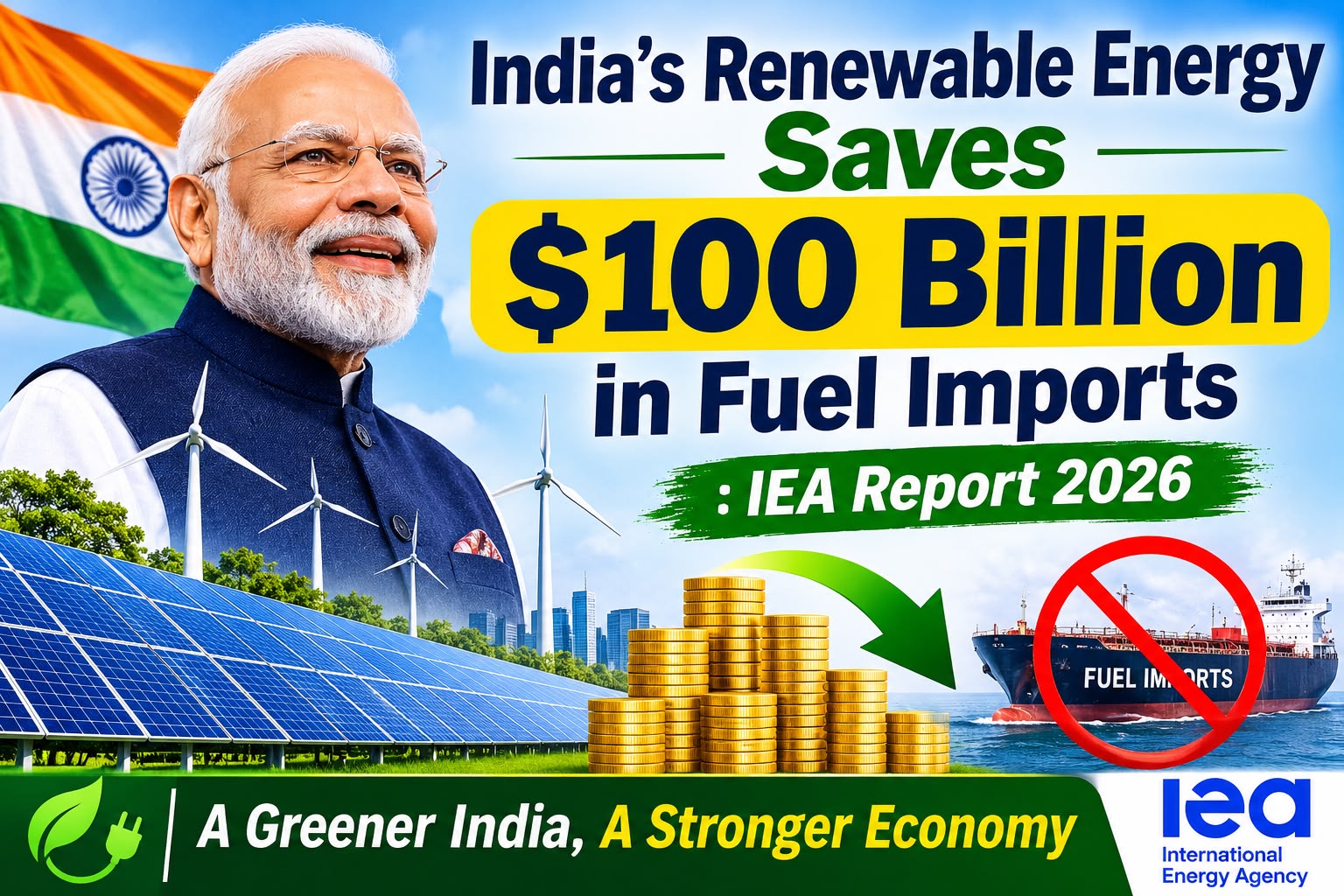
India's Renewable Energy Boom Saves $100 Billion in Fuel Imports: IEA Reveals Massive Economic Benefits
Published: November 7, 2026 | Category: Business, Energy & Economy
India's renewable energy revolution is delivering a major economic advantage, with the country saving more than $100 billion in coal and natural gas import expenditure between 2011 and 2025, according to the International Energy Agency (IEA). The achievement highlights how investments in solar, wind and other renewable energy sources are helping India reduce its dependence on imported fossil fuels while strengthening energy security and supporting long-term economic growth.
India is rapidly transforming its energy sector as electricity demand continues to increase across households, industries, commercial establishments and transportation. Traditionally, the country has relied heavily on conventional energy sources, including coal, crude oil and natural gas. However, the expansion of renewable electricity generation is gradually changing the country's energy landscape.
The IEA's latest assessment highlights that renewable energy is no longer simply an environmental initiative for India. It has become an important economic strategy that can reduce foreign exchange outflows, protect the economy from international fuel-price fluctuations and create new opportunities for domestic industries.
With India targeting significant renewable energy expansion by 2030, the financial benefits could become even greater in the coming years.
India Saves More Than $100 Billion Through Renewable Energy
According to the IEA, renewable electricity generation helped India avoid more than $100 billion in coal and natural gas import expenditure during 2011–2025.
This saving reflects the amount of imported fossil fuel that India did not need because electricity was generated through renewable sources such as solar, wind and bioenergy.
The report also estimates that without the solar, wind and bioenergy capacity added since 2010, India's coal imports in 2025 would have been approximately 110 million tonnes higher.
This is an important indicator of how renewable energy is reducing the country's dependence on international fuel supplies.
India imports energy resources to support electricity generation and industrial activities. When international coal and gas prices increase, the cost of meeting domestic energy demand can also rise. Renewable energy helps reduce this exposure by providing electricity from domestic natural resources.
The $100 billion saving is therefore not just an energy-sector achievement. It represents a significant contribution to India's economic resilience.
Renewable Energy Capacity Crosses 300 GW in India
India's renewable energy sector has experienced remarkable growth over the last decade. The country's renewable power capacity crossed 300 GW in the fourth quarter of 2026, almost quadrupling compared with levels recorded a decade earlier.
The IEA identifies India as the world's second-fastest-growing renewable energy market and the second-largest manufacturer of solar photovoltaic (PV) modules.
Another major achievement came in 2025, when India reached its target of sourcing 50% of installed electricity capacity from non-fossil fuel sources, five years ahead of its original 2030 deadline.
This milestone demonstrates the country's progress in diversifying its electricity generation infrastructure.
It is important to understand that non-fossil capacity includes renewable sources such as solar, wind and hydropower, as well as nuclear energy.
Solar Energy to Lead India's Renewable Energy Expansion
Solar power is expected to become the biggest contributor to India's renewable energy expansion through 2030.
The country's geographical conditions, increasing electricity demand and competitive solar tariffs have encouraged investments in large-scale solar parks as well as rooftop installations.
According to the IEA, solar PV will account for more than 80% of India's additional renewable power capacity through 2030.
The agency expects solar PV capacity to exceed 350 GW by 2030.
Several factors are supporting this growth:
- Increasing investments in utility-scale solar power projects.
- Expansion of residential rooftop solar installations.
- Government subsidies and policy support.
- Competitive electricity tariffs.
- Growing demand from commercial and industrial consumers.
- Increasing domestic manufacturing of solar modules.
India's utility-scale solar generation costs are estimated at approximately $30–35 per megawatt-hour, placing the country among the most competitive solar electricity markets globally.
The IEA also notes that tariffs for solar PV projects commissioned in 2025 were approximately 40% below the average cost of coal-fired electricity generation.
This cost advantage is making solar energy increasingly attractive to electricity producers and large consumers.
Wind Energy Strengthens India's Clean Power Strategy
Wind energy is another important contributor to India's renewable energy development.
States such as Gujarat, Tamil Nadu, Karnataka, Maharashtra and Rajasthan have significant wind energy potential.
Unlike solar power, which primarily generates electricity during daylight hours, wind energy can generate electricity at different times depending on weather conditions.
This makes solar and wind complementary technologies.
The IEA projects India's wind power capacity to approach 90 GW by 2030.
The development of hybrid renewable energy projects combining solar and wind is also gaining momentum. These projects can provide a more balanced electricity generation profile and make better use of land and transmission infrastructure.
In 2025, India auctioned approximately 15 GW of hybrid renewable energy projects, the largest annual volume globally, according to the IEA.
Rooftop Solar and Government Schemes Are Driving Wider Adoption
India's renewable energy growth is not limited to large power plants. Residential households, commercial establishments and industrial consumers are increasingly exploring solar electricity to reduce their dependence on conventional power supplies.
The government's PM Surya Ghar: Muft Bijli Yojana is encouraging residential rooftop solar adoption by providing financial support to eligible households.
The programme aims to make solar electricity more accessible and reduce household electricity expenditure.
The IEA expects distributed solar capacity for self-consumption to exceed 100 GW by 2030, approximately three times its current level.
Other important government initiatives include:
1. PM Surya Ghar: Muft Bijli Yojana: Promotes residential rooftop solar installations and household-level electricity generation.
2. PM-KUSUM: Supports solar-powered agricultural pumps and solarisation of agricultural electricity infrastructure.
3. Production Linked Incentive Scheme: Encourages domestic manufacturing of high-efficiency solar PV modules.
4. Green Energy Corridors: Strengthens electricity transmission infrastructure to connect renewable energy generation centres with consumption areas.
These initiatives are helping expand renewable energy adoption across different sections of the economy.
How Renewable Energy Is Improving India's Energy Security
One of the most important advantages of renewable energy is its ability to reduce India's vulnerability to international fuel markets.
India's dependence on imported fossil fuels creates economic risks whenever global commodity prices increase.
International conflicts, geopolitical tensions, shipping disruptions and supply shortages can increase fuel procurement costs.
Renewable electricity reduces some of these risks by allowing India to generate a greater share of its electricity domestically.
The IEA highlights that without the solar, wind and bioenergy capacity added since 2010, India's electricity-generation import dependence would have exceeded 30% in 2025, approximately twice the actual level.
The benefits extend beyond electricity generation.
Domestic biofuel production also reduces the need for imported petroleum products. According to the IEA, biofuels reduced India's crude oil import dependence by approximately four percentage points in 2025.
Meanwhile, biogas offers another opportunity to replace imported natural gas with domestically produced energy.
This shows that India's energy transition is developing across multiple sectors, including electricity, transportation and heating.
India's Renewable Energy Could Save Nearly $240 Billion by 2030
The economic benefits of renewable energy could increase significantly over the next four years.
According to the IEA, cumulative savings on coal and natural gas imports could approach $240 billion by 2030.
This projection assumes that fuel prices remain broadly consistent with average levels observed during 2024–2025.
The agency estimates that annual fossil-fuel import savings could reach approximately $35 billion by 2030.
Solar PV is expected to contribute around 60% of the projected cumulative savings, while wind energy could contribute almost 30%.
This suggests that solar and wind will remain central to India's efforts to reduce fossil fuel import expenditure.
India's renewable energy outlook for 2030
|
Indicator |
IEA projection |
|
Renewable power capacity |
Around 530 GW |
|
Solar PV capacity |
More than 350 GW |
|
Wind power capacity |
Nearly 90 GW |
|
Hydropower capacity |
Around 75 GW |
|
Renewable electricity generation |
Nearly 950 TWh |
|
Share of electricity from renewables |
Around 35% |
|
Cumulative coal and gas import savings |
Nearly $240 billion |
Source: IEA India Renewable Energy Market Report 2026. Figures represent projections and may vary with actual project execution and market conditions.
Renewable Energy Creates New Business and Employment Opportunities
India's clean energy transition is creating opportunities across the infrastructure, manufacturing and technology sectors.
The growing number of renewable energy projects requires specialised services at every stage, from project development and engineering to installation, commissioning and maintenance.
Some of the major business opportunities include:
Solar EPC services: Engineering, procurement and construction companies are expected to benefit from increasing demand for utility-scale and rooftop solar installations.
Electrical infrastructure: Renewable projects require transformers, switchgear, cables, substations, protection systems and transmission infrastructure.
Battery energy storage: Increasing solar and wind generation will create demand for battery storage technologies and energy management solutions.
Operations and maintenance: Solar and wind installations require regular inspections, preventive maintenance, technical support and performance monitoring.
Domestic manufacturing: Solar modules, inverters, batteries and power electronics offer opportunities for Indian manufacturers.
Electric vehicle infrastructure: Renewable electricity can support the expansion of EV charging networks and improve the environmental benefits of electric mobility.
The expansion of renewable energy could therefore create a wider ecosystem of businesses, skilled workers, engineering companies and infrastructure service providers.
Major Challenges That Could Slow India's Renewable Energy Growth
Despite its impressive progress, India faces several challenges in achieving its renewable energy ambitions.
1. Power transmission infrastructure
Solar and wind projects are often located far from major cities and industrial centres. India needs stronger transmission networks to transport electricity efficiently.
2. Battery storage requirements
Solar generation is concentrated during daylight hours. Battery storage and pumped hydro projects will be essential to provide electricity when solar and wind generation is low.
3. Financial condition of DISCOMs
The financial health of electricity distribution companies remains a concern. Delayed payments and accumulated losses can affect renewable energy developers and investors.
4. Land acquisition and project delays
Large renewable energy projects require land, regulatory approvals and transmission connectivity. Delays in these areas can increase costs and affect project completion.
5. Domestic manufacturing and supply chains
India has significantly expanded solar module manufacturing, but dependence on imported upstream components remains a challenge. Developing domestic manufacturing of solar cells, wafers and other critical components will be important.
The IEA estimates that addressing these challenges could accelerate India's renewable power capacity deployment by more than 20% during 2026–2030.
What Does This Mean for India's Economy?
The renewable energy transition has the potential to reshape India's economic structure over the coming years.
Saving billions of dollars in fuel imports can reduce pressure on the country's external payments and improve energy security.
At the same time, investments in renewable energy infrastructure can support domestic manufacturing, employment generation and technological development.
For consumers, increasing renewable electricity generation can offer greater access to competitively priced power, although actual electricity bills will also depend on transmission costs, distribution charges, storage requirements and state-level tariffs.
For businesses, the expansion of solar, wind and battery storage creates opportunities to reduce energy costs and improve sustainability.
For the government, renewable energy provides a strategic opportunity to balance economic growth with environmental commitments.
Conclusion: India's Renewable Energy Transition Is Becoming an Economic Game Changer
India's achievement of avoiding more than $100 billion in coal and natural gas import expenditure through renewable electricity is a significant milestone in its energy transition.
The latest IEA report makes one thing clear: renewable energy is delivering benefits that extend well beyond reducing carbon emissions.
From strengthening energy security and lowering exposure to international fuel prices to supporting domestic manufacturing and creating new business opportunities, clean energy is becoming an important pillar of India's economic development.
With renewable power capacity projected to reach approximately 530 GW by 2030 and cumulative coal and natural gas import savings potentially approaching $240 billion, India has an opportunity to further strengthen its position in the global clean energy market.
However, achieving this ambition will require sustained investment in electricity grids, battery storage, domestic manufacturing and project execution.
India's renewable energy revolution is no longer just about producing cleaner electricity. It is increasingly about building a stronger, more self-reliant and economically resilient nation.
What's Hot
-

India WTC Final 2027 Qualification Chances: What Team India Needs
-

India Score 720/9 vs New Zealand: Highest Away Test Total, Historic Record
-

Georgia Beats South Carolina 34-6 to Clinch 2026 SEC Championship Berth
-

PM E-DRIVE Scheme Crosses 30 Lakh EV Sales Milestone
-

PM Modi's FICCI Speech 2026: Listen to Gandhi, Promote Swadeshi and Make India Self-Reliant
-

Trump, Xi and Putin Summit 2026: Key Agenda, Nuclear Weapons, Iran War and Ukraine
-

EV Sales Surge 69% in India During 2026 Festive Season
-

What Is ASEAN? 11 Member Countries and Why It Matters to India
-

India vs New Zealand 4th ODI: India Bowled Out for 89, Lose by 244 Runs
-

PM Modi to Launch Rs.15,600 Crore Development Projects in Bengaluru Today