

Electric Car Sales in India September 2026: Tata Motors Leads as Mahindra, VinFast and Kia Surge
Electric Car Sales in India September 2026: Tata Motors Leads as Mahindra, VinFast and Kia Surge
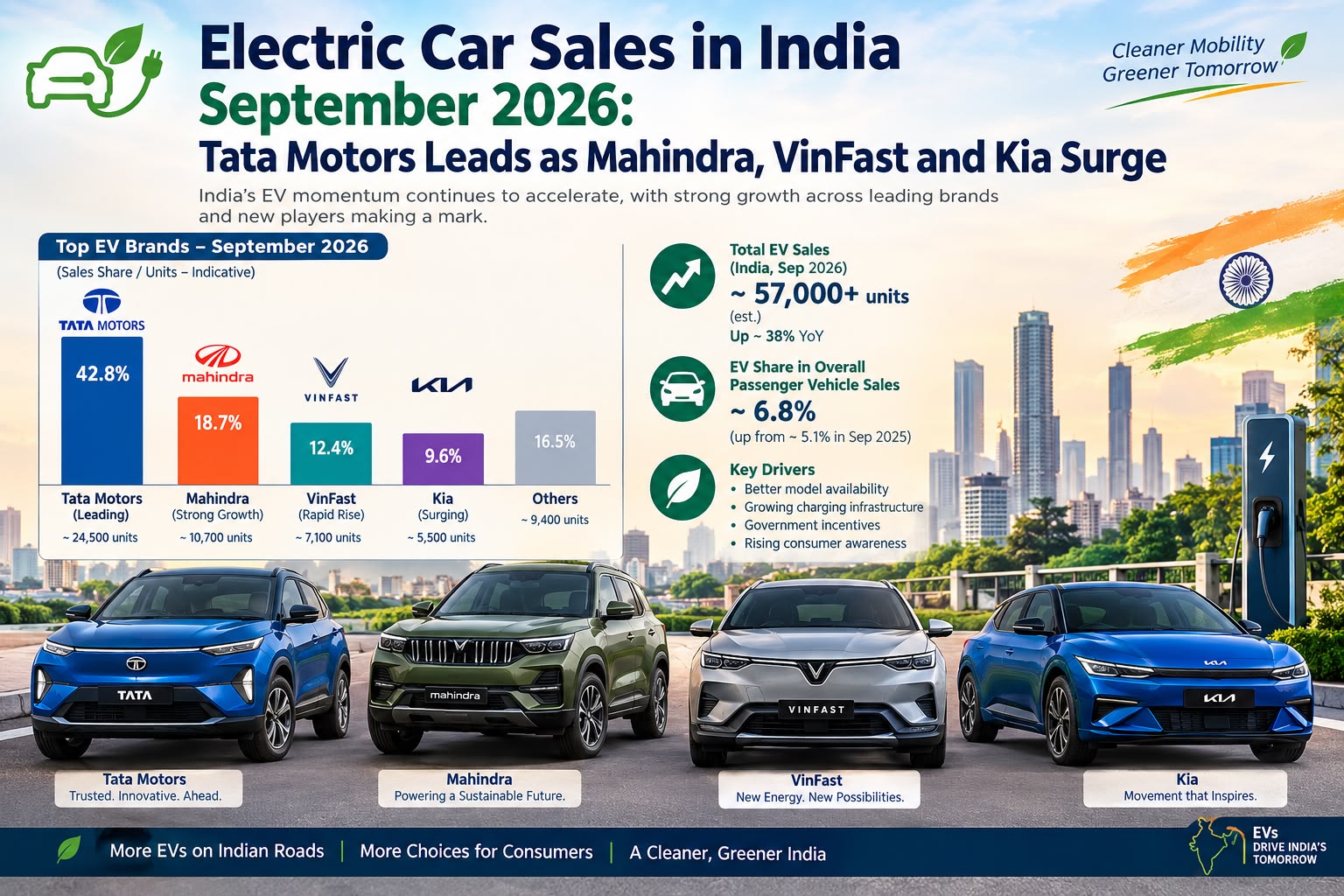
India's electric passenger-vehicle market recorded exceptional growth in September 2026, with sales almost doubling year-on-year. Tata Motors retained the top position, while Mahindra strengthened its second position and VinFast emerged as a major new competitor. Kia also recorded a sharp increase in sales, overtaking Maruti Suzuki during the month.
India's electric-car market continued its rapid expansion in September 2026, reflecting growing consumer interest in cleaner mobility, improving EV technology and an expanding range of electric SUVs.
According to retail registration data, India's electric passenger-vehicle sales reached 36,108 units in September 2026, compared with 18,559 units in September 2025. This represents a 94.56% year-on-year increase.
Sales also increased from approximately 30,696 units in August to 36,108 units in September, registering 17.63% month-on-month growth.
Electric passenger vehicles accounted for approximately 8.5% of India's total passenger-vehicle retail sales during September, compared with around 5.7% in the same month last year.
Tata Motors Remains India's EV Market Leader
Tata Motors continued to dominate India's electric-car market in September 2026.
The company recorded 14,791 electric passenger-vehicle sales, giving it an estimated 41% share of the country's EV passenger-car market.
Tata's September sales were more than double the 7,369 units recorded in September 2025, representing approximately 100.72% year-on-year growth.
Sales also increased 12.41% compared with August 2026.
Tata's extensive EV portfolio remains one of its biggest advantages. The company's electric range includes models such as the Punch EV, Nexon EV, Tiago EV and Harrier EV, allowing Tata to serve customers across multiple price categories.
Mahindra Strengthens Its Challenge to Tata
Mahindra emerged as the second-largest electric passenger-vehicle manufacturer in September, with 7,780 units sold.
The company's sales increased from 3,973 units in September 2025, representing 95.82% year-on-year growth.
Mahindra also recorded 20.36% month-on-month growth, increasing from 6,464 units in August.
With approximately 21.5% market share, Mahindra has established itself as the strongest challenger to Tata Motors.
Its focus on electric SUVs has played an important role in this growth. Models such as the BE 6, XEV 9e and XEV 9Shave helped Mahindra establish a strong position in India's premium electric-SUV segment.
Tata and Mahindra Control More Than 60% of the Market
The dominance of Tata and Mahindra is one of the most important trends visible in the September sales data.
Together, the two companies sold 22,571 electric vehicles, accounting for approximately 62.5% of India's electric passenger-vehicle market.
This indicates that while competition is increasing, the market remains highly concentrated at the top.
MG Motor Holds Third Position
JSW MG Motor India retained third position with 5,242 electric vehicles sold in September.
The company's sales increased 13.41% compared with August, when it sold 4,622 units.
Year-on-year growth stood at approximately 9.14%.
MG's estimated market share was around 14.5%.
The MG Windsor EV continues to be an important contributor to the company's electric-vehicle sales.
However, MG's annual growth rate was significantly lower than Tata and Mahindra, indicating increasing competitive pressure in the segment.
VinFast Emerges as a Major New EV Player
VinFast was one of the biggest stories of India's September EV market.
The Vietnamese electric-vehicle manufacturer sold 2,964 units, moving into fourth position.
Sales increased 34.79% month-on-month, from 2,199 units in August.
VinFast's September sales represented approximately 8.2% of India's electric passenger-vehicle market.
The company's rapid rise demonstrates how quickly new EV manufacturers can gain market share in India's expanding electric-car market.
VinFast's electric SUV portfolio, including the VF 6 and VF 7, has helped it establish a presence across important segments.
Kia Overtakes Maruti Suzuki
Kia recorded one of the strongest performances among established manufacturers.
The company sold 1,262 electric vehicles in September, compared with 645 units in August.
This represents a massive 95.66% month-on-month increase.
Kia also recorded 111.04% year-on-year growth.
The strong performance allowed Kia to overtake Maruti Suzuki in the monthly electric-car sales ranking.
Kia's estimated market share stood at approximately 3.5%.
Maruti Suzuki Faces Growing EV Competition
Maruti Suzuki sold 1,104 electric vehicles in September, compared with 1,412 units in August.
The company therefore recorded a 21.81% month-on-month decline.
Maruti's electric-car market share was approximately 3.1% during the month.
The company's e Vitara is currently its major electric offering in India.
The September figures highlight an important difference between India's conventional automobile market and its EV market. Maruti remains India's dominant passenger-car manufacturer overall, but it is still building its position in electric vehicles.
A wider EV portfolio and additional launches could significantly change Maruti's position over the next few years.
BYD Continues to Expand
Chinese EV manufacturer BYD sold 836 electric vehicles in September.
Sales increased 53.96% month-on-month and 35.93% year-on-year.
BYD's estimated market share was approximately 2.3%.
The company continues to focus primarily on the premium and upper-mid-market segments.
Its global battery expertise and extensive electric-vehicle portfolio make BYD an important competitor in India's premium EV market.
Hyundai Records Strong Year-on-Year Growth
Hyundai sold 792 electric vehicles in September.
Although monthly sales declined marginally from 803 units in August, Hyundai recorded 52.02% year-on-year growth.
The company currently holds approximately 2.2% of India's electric passenger-vehicle market.
The Creta Electric is an important part of Hyundai's EV strategy in India.
Hyundai's established dealer network and strong brand presence give it significant potential to increase its EV market share as the company expands its electric portfolio.
BMW Leads the Luxury EV Segment
BMW sold 502 electric vehicles in September, compared with 274 units in August.
This represents 83.21% month-on-month growth.
BMW's year-on-year growth stood at approximately 36%.
The performance demonstrates that EV adoption is also accelerating in India's luxury-car segment.
Premium brands are increasingly expanding their electric portfolios as demand for high-performance and technology-focused EVs grows among Indian consumers.
September 2026 EV Sales: Key Numbers
|
Manufacturer |
September 2026 Sales |
Approx. Market Share |
YoY Growth |
|
Tata Motors |
14,791 |
41.0% |
100.72% |
|
Mahindra |
7,780 |
21.5% |
95.82% |
|
JSW MG Motor |
5,242 |
14.5% |
9.14% |
|
VinFast |
2,964 |
8.2% |
— |
|
Kia |
1,262 |
3.5% |
111.04% |
|
Maruti Suzuki |
1,104 |
3.1% |
— |
|
BYD |
836 |
2.3% |
35.93% |
|
Hyundai |
792 |
2.2% |
52.02% |
|
BMW |
502 |
1.4% |
36.04% |
Source: FADA retail-registration data and industry reports. Market-share figures are calculated against total September EV passenger-vehicle sales of 36,108 units.
EV Penetration Reaches 8.5%
One of the most important indicators from September is EV penetration.
Electric passenger vehicles represented approximately 8.5% of total passenger-vehicle retail sales during the month.
This compares with approximately 5.7% in September 2025.
The increase shows that EV adoption is accelerating faster than the overall passenger-car market.
If this trend continues, India's electric passenger-vehicle market could move toward double-digit market penetration in the coming years.
Conclusion
September 2026 was a significant month for India's electric passenger-vehicle industry.
With 36,108 EVs sold, the market recorded nearly 95% year-on-year growth and reached approximately 8.5% EV penetration.
What's Hot
-

India WTC Final 2027 Qualification Chances: What Team India Needs
-

India Score 720/9 vs New Zealand: Highest Away Test Total, Historic Record
-

Georgia Beats South Carolina 34-6 to Clinch 2026 SEC Championship Berth
-
PM E-DRIVE Scheme Crosses 30 Lakh EV Sales Milestone
-

PM Modi's FICCI Speech 2026: Listen to Gandhi, Promote Swadeshi and Make India Self-Reliant
-

Trump, Xi and Putin Summit 2026: Key Agenda, Nuclear Weapons, Iran War and Ukraine
-
EV Sales Surge 69% in India During 2026 Festive Season
-

What Is ASEAN? 11 Member Countries and Why It Matters to India
-

India vs New Zealand 4th ODI: India Bowled Out for 89, Lose by 244 Runs
-
PM Modi to Launch Rs.15,600 Crore Development Projects in Bengaluru Today