

Apple First Touchscreen MacBook Pro Launched in India: Price and Features
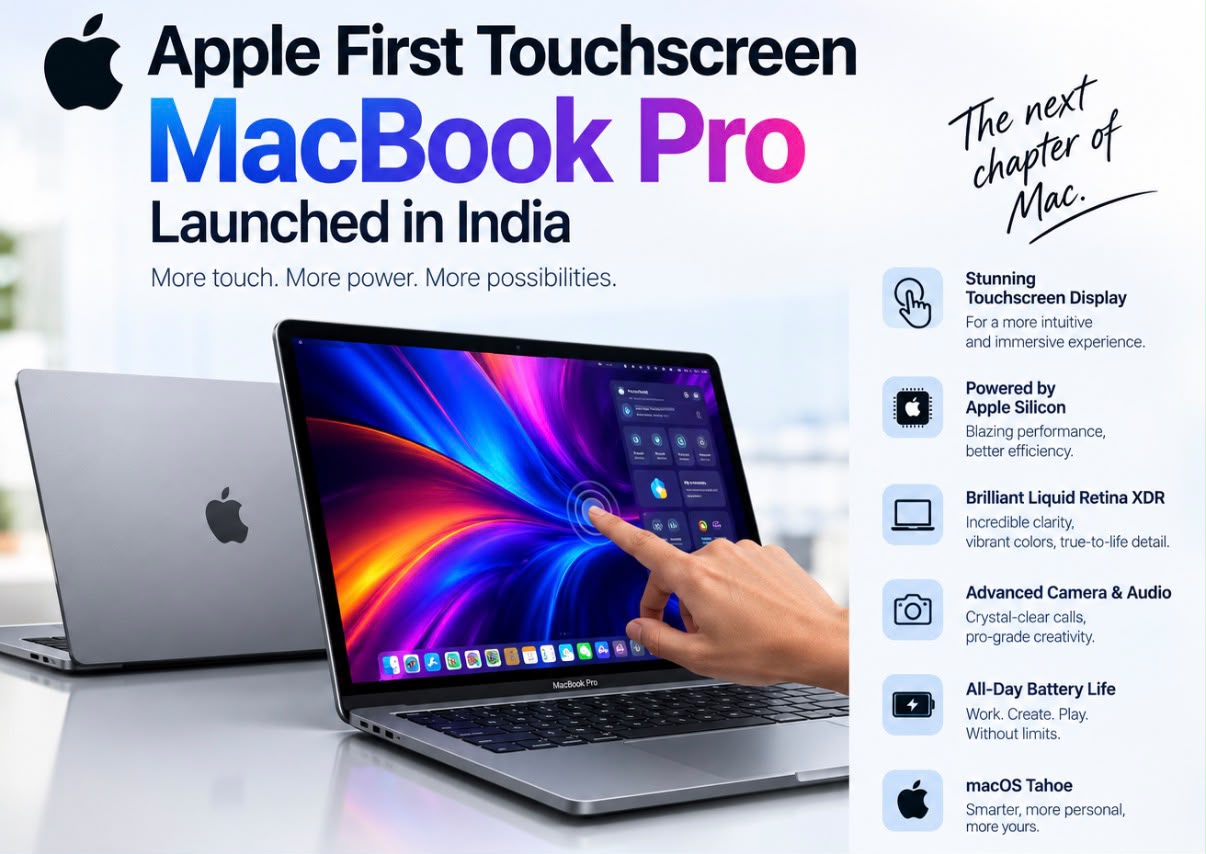
Apple Introduces Its First Touchscreen MacBook Pro
Apple has officially introduced its first touchscreen MacBook Pro, marking a major change in the company's approach to laptop design. Announced on October 28, 2026, the new MacBook Pro brings touchscreen functionality to the Mac for the first time, allowing users to interact directly with content on the display.
The new models combine a tandem OLED-based PROLED XDR display, Apple's M5 Pro and M5 Max processors, Dynamic Island functionality and enhanced artificial intelligence capabilities. Available in 14-inch and 16-inch configurations, the laptop is designed primarily for professionals, content creators, developers and users who require powerful computing performance.
The introduction of touch controls is particularly significant because Apple has traditionally relied on the keyboard, trackpad and mouse for Mac navigation rather than touchscreen displays. The new MacBook Pro changes that approach while retaining the familiar macOS desktop experience.
According to Apple's announcement, the new laptop also offers up to 24 hours of battery life, a high-refresh-rate display and configurations with up to 128GB of unified memory and 16TB of storage.
Apple MacBook Pro Touchscreen: What's New?
The biggest highlight of the new MacBook Pro is its touchscreen display. Users can now interact with macOS by touching the screen instead of relying exclusively on the trackpad or mouse.
The touchscreen supports several familiar gestures, including tapping, swiping, pinching to zoom and dragging content across the display. These functions can make everyday tasks more intuitive, particularly when working with photographs, presentations, graphics and creative applications.
Apple has designed touch interaction specifically for the Mac rather than simply copying the iPad interface. Users can continue working with a traditional keyboard and trackpad while using touch whenever it makes a task easier.
For professionals, this approach could be especially useful when editing visual content, manipulating 3D objects, arranging presentation slides or interacting with compatible creative applications.
The new MacBook Pro also introduces Dynamic Island to the Mac, bringing a feature previously associated with the iPhone into Apple's laptop ecosystem. It provides a dedicated interface for activities such as Spotlight, Live Activities and Siri-related functions.
Together, these changes represent one of the most significant interface developments in the MacBook Pro's history.
Apple MacBook Pro 2026: Price in India
Apple's first touchscreen MacBook Pro is positioned firmly in the premium laptop segment. Its price varies depending on the display size and processor configuration.
The announced Indian starting prices are:
|
Model |
Starting Price in India |
|
14-inch MacBook Pro with M5 Pro |
Rs.3,49,900 |
|
16-inch MacBook Pro with M5 Pro |
Rs.4,09,900 |
|
14-inch MacBook Pro with M5 Max |
Rs.5,49,900 |
|
16-inch MacBook Pro with M5 Max |
Rs.5,89,900 |
Eligible education customers can access lower prices, starting at Rs.3,31,900 for the 14-inch M5 Pro model.
These are the announced starting prices; the final cost can increase depending on the selected memory, storage and other configuration options.
Is Apple's First Touchscreen MacBook Expensive?
Yes. With a starting price of Rs.3,49,900, the touchscreen MacBook Pro is targeted primarily at professionals and users who need high-end computing capabilities.
The premium pricing reflects its combination of a tandem OLED display, powerful Apple silicon, advanced graphics capabilities and professional-grade features.
However, buyers should consider whether they genuinely need touchscreen functionality alongside the MacBook Pro's existing capabilities. Users who primarily browse the internet, attend online meetings, edit documents and perform routine office work may find a less expensive MacBook sufficient.
For video editors, developers, designers and other professionals, the additional capabilities may offer greater value depending on their workloads.
Display: Tandem OLED Technology and PROLED XDR
The display is another major highlight of Apple's new touchscreen MacBook Pro.
The laptop uses Apple's tandem OLED-based PROLED XDR display technology, designed to deliver improved contrast, deeper blacks, bright highlights and detailed colour reproduction.
Apple lists the following display features:
- Tandem OLED display technology.
- Up to 2,000 nits of peak brightness.
- A claimed contrast ratio of 10,000,000:1.
- ProMotion technology with a refresh rate of up to 120Hz.
- Support for P3 and Adobe RGB colour gamuts.
- Multi-touch gesture support.
- An optional nano-texture finish to help reduce reflections.
These features are particularly relevant for professionals working with photographs, video production, animation, visual effects and colour-sensitive creative projects.
The 120Hz refresh rate can also make scrolling, animations and compatible creative workflows feel smoother.
The touchscreen sensor is integrated into the display panel, which Apple says helps reduce latency and make interactions feel more direct.
For users upgrading from older MacBook Pro models, the combination of OLED technology and touch support could be one of the most noticeable changes.
Performance: Apple M5 Pro and M5 Max Chips
The touchscreen MacBook Pro is powered by Apple's M5 Pro and M5 Max processors.
These chips are designed for demanding workloads, including software development, professional video editing, graphics-intensive applications, 3D rendering and artificial intelligence tasks.
M5 Pro
The M5 Pro configuration is intended for professionals who need high performance for everyday creative and technical workloads.
Potential use cases include:
- Software development and application testing.
- Professional photo editing.
- Video editing and post-production.
- Business analytics and multitasking.
- AI-assisted productivity.
- Running demanding professional applications.
M5 Max
The M5 Max configuration is aimed at users who require more advanced graphics and computing capabilities.
It is particularly relevant to professionals working with complex visual effects, 3D animation, large creative projects and demanding AI development workloads.
The new MacBook Pro supports up to 128GB of unified memory and configurations with up to 16TB of storage, depending on the model and selected options.
For professionals who regularly work with large files and resource-intensive applications, these configurations can provide substantial flexibility.
However, actual performance will depend on the processor configuration, application, workload and other system settings.
Battery Life: Up to 24 Hours
Apple claims that the new touchscreen MacBook Pro can deliver up to 24 hours of battery life.
Long battery life is particularly important for professionals who travel frequently, attend meetings across different locations or work away from a desk.
Combined with the laptop's high-performance processors, the claimed battery life could make the device suitable for extended working sessions without needing to remain connected to a power outlet.
Actual battery performance will vary depending on display brightness, applications, workload, network activity and configuration.
Users performing intensive video rendering, graphics processing or AI workloads should expect battery consumption to differ from that experienced during lighter productivity tasks.
Dynamic Island Comes to Mac
Another notable addition is Dynamic Island, which Apple is bringing to the Mac for the first time.
On compatible MacBook Pro models, the feature provides an interactive area for functions such as Spotlight, Live Activities and Siri-related capabilities.
The addition could make certain system functions easier to access without interrupting the main application window.
Its usefulness will depend on how Apple integrates the feature with macOS and how developers adapt their applications to the new interface.
For users already familiar with Dynamic Island on the iPhone, its arrival on the Mac could create a more consistent experience across Apple devices.
How Will the Touchscreen Change the MacBook Experience?
For years, Apple has maintained a clear distinction between the MacBook and iPad.
MacBooks have focused on traditional desktop computing, while iPads have offered a touch-first experience. The introduction of a touchscreen MacBook Pro brings these interaction styles closer together.
1. Easier Navigation
Users can tap buttons, swipe through webpages, zoom into photographs and interact directly with on-screen content.
This may be convenient for people who frequently switch between touch-enabled devices and laptops.
2. Better Creative Workflows
Graphic designers, photographers and other creative professionals may benefit from direct interaction with visual elements.
For example, touching and manipulating objects on the screen could make certain tasks more intuitive than controlling every action through a trackpad.
3. More Flexible Multitasking
Touch gestures may provide another way to arrange windows, navigate applications and manage content.
The keyboard and trackpad remain important, but users gain an additional input method.
4. Opportunities for App Developers
Developers may explore new ways to design Mac applications that take advantage of direct touch input.
Apple has also highlighted the ability for developers to test touch interactions in their iOS and iPadOS applications directly on the MacBook Pro display.
The long-term impact will depend on software support and whether developers find meaningful uses for touchscreen functionality.
Apple Touchscreen MacBook vs Traditional MacBook Pro
The primary difference between the new touchscreen model and traditional MacBook Pro laptops is the way users interact with the computer.
|
Feature |
Traditional MacBook Pro |
Touchscreen MacBook Pro |
|
Primary navigation |
Keyboard, trackpad and mouse |
Keyboard, trackpad, mouse and touch |
|
Display technology |
Varies by generation and model |
Tandem OLED-based PROLED XDR |
|
Touch input |
Not available on traditional models |
Supported |
|
Touch gestures |
Limited to supported trackpad gestures |
Direct gestures on the display |
|
Dynamic Island |
Not part of older models |
Introduced with the new model |
|
Intended users |
Students, professionals and creators |
Professionals and creators seeking additional touch functionality |
The exact differences depend on which older MacBook Pro generation is used for comparison.
It is also worth noting that the touchscreen does not eliminate the need for a keyboard or trackpad. For many professional tasks, these traditional controls remain more practical.
What Does Apple's Touchscreen MacBook Mean for India?
The launch is significant for India's premium laptop market, where Apple's MacBook Pro lineup competes with high-performance Windows laptops and mobile workstations.
1. A New Option for Creative Professionals
India's growing communities of video editors, designers, developers, digital creators and production professionals may be interested in the new model.
The combination of a high-quality display, powerful processors and touch input offers another option for people working with visual content.
2. Premium Pricing May Limit Mass-Market Demand
Starting at Rs.3,49,900, the touchscreen MacBook Pro is beyond the budget of many students and everyday laptop users.
The product is therefore more likely to appeal to professionals, businesses and buyers who specifically require its advanced features.
3. Competition in the Premium Laptop Segment
Windows laptop manufacturers have offered touchscreen devices for years, including conventional laptops and convertible models.
Apple's entry into touchscreen MacBooks could encourage greater competition around display technology, user experience, software integration and premium laptop design.
However, the new MacBook Pro's pricing means it will compete primarily in the high-end segment rather than across the entire laptop market.
4. Potential Benefits for Businesses
Companies working in software development, media production, design and other technical fields may evaluate the touchscreen MacBook Pro for employees with specialised requirements.
For businesses, the purchasing decision will depend on performance needs, application compatibility, device management and the overall cost of ownership.
Should You Buy Apple's First Touchscreen MacBook Pro?
The answer depends on your budget and the type of work you perform.
Consider buying it if:
- You regularly work with professional creative applications.
- You need a high-quality display for photography or video production.
- You use demanding software development or graphics workflows.
- You want touch input alongside traditional Mac controls.
- Your work benefits from the processing capabilities of the M5 Pro or M5 Max.
Consider a less expensive MacBook if:
- Your primary tasks involve browsing, email and office applications.
- You do not need a touchscreen.
- Your existing MacBook already meets your performance requirements.
- You are working within a limited budget.
For existing MacBook Pro owners, upgrading solely for touchscreen support may not be worthwhile unless the new interface offers a meaningful benefit to their workflow.
For users who already need a high-end MacBook, however, the new display and touch capabilities may make the device more attractive.
Apple's First Touchscreen MacBook: Availability in India
Apple announced the new touchscreen MacBook Pro on October 28, 2026, with pre-orders opening that day in selected markets.
Apple's announcement listed November 9 as the start of customer deliveries and availability at Apple Store locations and authorised resellers for the touchscreen PROLED XDR models. Buyers in India should confirm the applicable local availability date and configuration details through Apple's official Indian store.
Final Verdict
Apple's first touchscreen MacBook Pro represents a major change in how the company approaches laptop interaction.
By combining touchscreen support with tandem OLED display technology, M5 Pro and M5 Max processors, Dynamic Island and professional-grade configurations, Apple is expanding the MacBook Pro experience beyond traditional keyboard-and-trackpad controls.
The biggest question is whether touchscreen functionality will become an essential part of the Mac experience or remain an additional convenience for selected users.
For creative professionals and technology enthusiasts, the launch is an important development. For everyday users, the high starting price means the decision will depend on whether the new features justify the additional investment.
Ultimately, Apple's first touchscreen MacBook Pro is not simply about adding touch to a laptop. It is about giving Mac users another way to interact with their work while retaining the core capabilities of macOS.
What's Hot
-

India WTC Final 2027 Qualification Chances: What Team India Needs
-

India Score 720/9 vs New Zealand: Highest Away Test Total, Historic Record
-

Georgia Beats South Carolina 34-6 to Clinch 2026 SEC Championship Berth
-

PM E-DRIVE Scheme Crosses 30 Lakh EV Sales Milestone
-

PM Modi's FICCI Speech 2026: Listen to Gandhi, Promote Swadeshi and Make India Self-Reliant
-

Trump, Xi and Putin Summit 2026: Key Agenda, Nuclear Weapons, Iran War and Ukraine
-

EV Sales Surge 69% in India During 2026 Festive Season
-

What Is ASEAN? 11 Member Countries and Why It Matters to India
-

India vs New Zealand 4th ODI: India Bowled Out for 89, Lose by 244 Runs
-

PM Modi to Launch Rs.15,600 Crore Development Projects in Bengaluru Today